Are AI Wearables Worth It? A Practical Guide for 2026
AI wearables promise to make you healthier, more connected, and more productive. But do they actually deliver? After testing dozens of devices, here's our honest answer.
By AI Wearable Hub Editorial Team · Published
Affiliate Disclosure: AI Wearable Hub is reader-supported. We participate in the Amazon Associates program — links on this page may earn us a commission at no extra cost to you. Prices are from Amazon and subject to change. All editorial opinions are our own.
What "AI Wearable" Actually Means in 2026
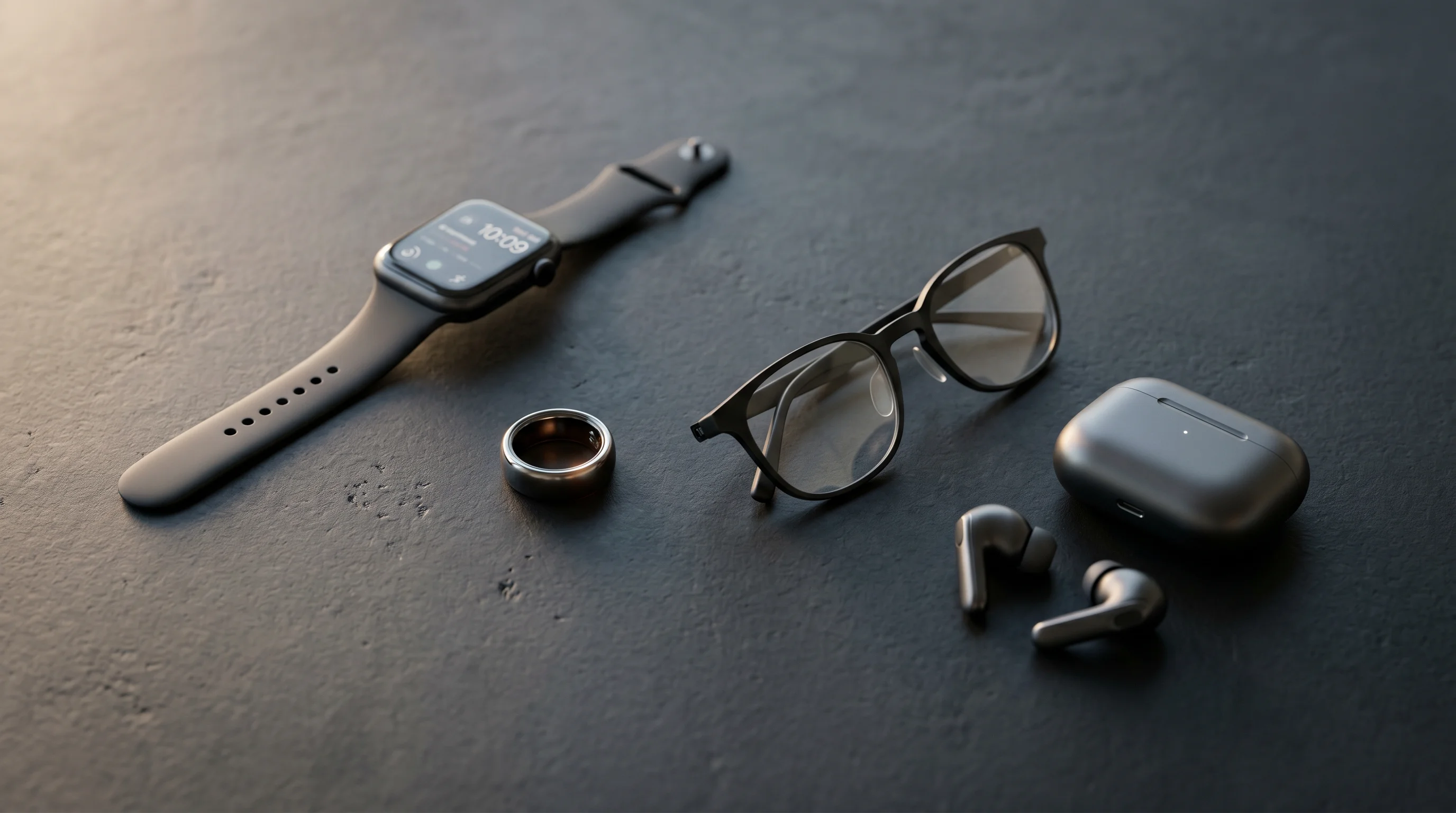
The term "AI wearable" has been stretched to cover everything from a fitness band with a step counter to a screenless device that projects information onto your palm. For this guide, we use a useful working definition: an AI wearable is a body-worn device where artificial intelligence meaningfully changes what it can do — not just display data, but interpret it, act on it, or enable capabilities that hardware alone cannot provide.
By that standard, the category is genuinely useful in 2026, and the devices available now are substantially better than those from two years ago. But the category is also still maturing, and buying at the wrong moment — or the wrong device — is easy to do.
The Six Categories: What Each One Actually Does
Smart Rings
Smart rings are the most practical AI wearable for health-focused users who want data without wearing a watch. Devices like the Oura Ring Gen 3 and Samsung Galaxy Ring track sleep stages, heart rate variability, blood oxygen, and skin temperature continuously — and translate that data into daily readiness and recovery scores. The ring form factor's main advantage is compliance: you wear a ring all the time, which produces more complete data than a smartwatch you take off for charging or discomfort.
The main considerations are subscription costs (Oura charges $5.99/month after the first month) and the fact that rings don't replace smartwatch features — no notifications, no GPS, no display.
AI Glasses
AI glasses in 2026 split into two distinct categories: social wearables with AI assistants (Meta Ray-Ban Smart Glasses) and AR display glasses (XREAL Air 2, Rokid Max). The social wearables are actually useful for a daily-carry audience — they look normal, the AI is responsive, and the hands-free photography is genuinely convenient. AR display glasses are excellent portable screens for remote workers and travelers but aren't conversational AI devices.
Neither category replaces your phone. Both are complementary tools at their best.
AI Earbuds
AI earbuds are the most immediately practical AI wearable for most people, because they replace something nearly everyone already uses. The AI adds real-time language translation (Pixel Buds Pro 2, AirPods Pro 2), adaptive noise cancellation that responds to your environment, and voice assistant integration that's faster and more capable than what smartphone speakers deliver. If you're going to spend money on only one AI wearable, earbuds offer the most accessible entry point.
Health Wearables
Fitness bands and health trackers have incorporated AI most successfully of all categories — partly because the problem space (tracking biometrics and generating insights) is well-defined. Whoop 4.0's recovery scoring, Fitbit's stress and sleep analysis, and Withings' clinical-grade ECG detection all represent AI making data genuinely more useful rather than more voluminous. The subscription costs are the main complexity: calculate your two-year total before buying.
AI Smartwatches
Premium smartwatches now incorporate AI primarily for health insight generation — trend analysis, anomaly detection, and personalized coaching. Apple Watch Ultra 2's irregular rhythm notifications and Samsung Galaxy Watch 6's personalized sleep coaching are the clearest examples of AI adding value beyond what the sensors alone could provide. The ecosystem lock-in is the key constraint: Apple Watch requires iPhone, and Galaxy Watch's best features require Galaxy phones.
AI Pins
AI pins — clip-on devices like the Humane AI Pin, Limitless Pendant, and Tab AI Necklace — are the most speculative category. The Humane AI Pin launched to mixed reviews as a proof-of-concept device that overreached its technology. The Limitless Pendant and Tab Necklace take a narrower approach (meeting capture and ambient memory) that's more immediately practical. This category is worth watching but isn't a mainstream recommendation yet.
The Total Cost of Ownership Problem
The most important thing most AI wearable buyers underestimate is the two-year cost of devices with subscription models. Here's a realistic breakdown:
- Whoop 4.0: $0 hardware + $239/year = $478 over two years
- Oura Ring Gen 3: $299 hardware + $143.88 subscription (2 years) = ~$443 over two years
- Fitbit Charge 6 + Premium: $159.95 hardware + $239.76 Premium (2 years) = ~$400 over two years
- Apple Watch SE 2nd Gen: $249 hardware + $0 subscription = $249 over two years
- Garmin Venu 3: $449.99 hardware + $0 subscription = $449.99 over two years
- Withings ScanWatch 2: $349.95 hardware + $0 subscription = $349.95 over two years
The subscription-model devices aren't necessarily worse value — Whoop's data quality genuinely justifies the cost for serious athletes. But the comparison looks very different over a two-year horizon than a simple hardware price comparison suggests.
Who Benefits Most from AI Wearables
Based on our experience evaluating these devices, certain profiles see consistently strong return on investment from AI wearables:
- Athletes training with performance goals: Recovery and strain data from Whoop or Oura changes training decisions in ways that improve outcomes
- Frequent international travelers: Real-time translation earbuds (Pixel Buds Pro 2, Galaxy Buds3 Pro) reduce friction significantly in multilingual environments
- Remote workers in noisy environments: Premium ANC earbuds with AI-driven noise filtering directly improve productivity
- People with health monitoring needs: FDA-cleared ECG and AFib detection on Apple Watch and Withings ScanWatch 2 provides clinically meaningful data
- Knowledge workers who want hands-free information access: Meta Ray-Ban Smart Glasses address a real daily friction for people who constantly look things up
Who Should Wait
Not everyone should buy an AI wearable in 2026. You should probably wait if:
- You're interested in AI glasses primarily as a fashion or status item — the technology isn't there yet for that to be satisfying
- You want AI pins as a phone replacement — that use case doesn't work reliably yet
- You're considering an AI wearable primarily because of marketing claims about health transformation — realistic expectations matter
- You're on the fence about a first-generation or recently-launched device — a six-month wait often produces meaningful software improvements
Starter Recommendations by Use Case
Best first AI wearable overall: Samsung Galaxy Ring (Android) or Oura Ring Gen 3 (iOS) — minimal friction, genuine daily data value, no lifestyle compromise required.
Best AI wearable for international travel: Google Pixel Buds Pro 2 (Android) or Apple AirPods Pro 2 (iPhone) — translation features work best within their respective ecosystems.
Best AI wearable for fitness: Whoop 4.0 (serious athletes) or Fitbit Charge 6 (everyday active users).
Best AI wearable for hands-free AI access: Meta Ray-Ban Smart Glasses — the only AI glasses that pass the "would you actually wear these daily" test for most people.
All prices listed are from Amazon and subject to change. Subscription pricing reflects rates at time of publication and may be updated by manufacturers. Always review current pricing before purchasing.
Frequently Asked Questions
What is an AI wearable exactly?
An AI wearable is any body-worn device that uses artificial intelligence to process data, provide insights, or respond to user needs. This includes smart rings that analyze your sleep and recovery, earbuds that translate languages in real time, smartwatches that detect irregular heart rhythms, and AI glasses that answer questions hands-free. The 'AI' component is meaningful when it produces personalized insights or enables capabilities that simple hardware alone cannot — and increasingly, it does.
How much do AI wearables actually cost when you include subscriptions?
Hardware prices are only part of the story. Whoop 4.0 has no upfront hardware cost but requires a membership (~$239/year). Oura Ring costs $299 plus $5.99/month (~$370 in year one). Fitbit Premium adds $9.99/month to the Charge 6's $159.95 purchase price. Apple Watch, Garmin, and Samsung devices provide full features without subscriptions. Over two years, subscription-model wearables often cost more than premium hardware-only alternatives.
Are AI wearables safe and private?
Reputable brands store health data encrypted and under privacy policies that prohibit selling to third parties. However, any device that continuously captures biometric data carries inherent privacy considerations. AI glasses and ambient recording devices (AI pins, necklaces) raise additional concerns about incidental capture of other people's conversations. Always review the privacy policy before purchasing, and understand what data is stored locally versus in the cloud.
Which AI wearable should I buy first?
For most people, start with either a smart ring (Oura Ring Gen 3 or Samsung Galaxy Ring) or upgrade your earbuds to an AI-capable pair (AirPods Pro 2 for iPhone users, Pixel Buds Pro 2 for Android). Smart rings are the lowest-friction wearable for health data — you wear one ring and forget it's there. AI earbuds replace something most people already use daily, making the upgrade feel natural rather than additive.
Will AI wearables get significantly better over the next few years?
Yes — the trajectory is clear. Sensor miniaturization is enabling more medical-grade capabilities (blood glucose monitoring without needles is in active development). On-device AI processing is eliminating cloud dependency for privacy-sensitive features. Form factors are shrinking and improving aesthetically. The major limitation today — limited battery life — is improving with every product generation. If you're on the fence, the devices available now are genuinely useful. If your use case feels barely covered, waiting 18–24 months will yield noticeably better options.