Humane AI Pin vs Rabbit R1: Which One Survived (and Should You Care)?
Both launched to disastrous reviews in April 2024. One is a bricked $699 doorstop. The other kept shipping updates and is still alive. Here is the full comparison -- and a straight answer on whether you should spend $199 on the Rabbit R1 today.
By AI Wearable Hub Editorial Team · Published
Affiliate Disclosure: AI Wearable Hub is reader-supported. We participate in the Amazon Associates program -- if you buy through links on this page, we may earn a commission at no extra cost to you. We research these products independently, and our editorial opinions are our own.
Quick Verdict
Do not buy the Humane AI Pin under any circumstances. Humane sold its software assets to HP in February 2025, shut down its servers on February 28, 2025, and every AI Pin in existence is now a non-functional slab of hardware. The Rabbit R1, currently $199 on Amazon, is the only device in this comparison that still works -- and after two years of steady over-the-air updates and the addition of OpenClaw agentic capabilities in January 2026, it has matured into something genuinely usable for the right person. It is not a smartphone replacement. But for technically curious users who want a dedicated, screenless-ish AI interface without a monthly subscription, it earns a cautious recommendation. For most people, there are better options: see our guide to whether AI wearables are worth it in 2026.
How We Evaluate AI Pins
We assess AI pin and companion devices on five criteria, weighted for real daily use: AI accuracy and response speed, hardware build quality, battery life, connectivity and ecosystem depth, and long-term value including subscription cost and company stability. For a device that depends entirely on cloud servers and a live company to function, that last criterion is not a footnote -- it is the ballgame. Both the Humane AI Pin and the Rabbit R1 taught us that lesson the hard way. Our coverage of the broader AI pins category applies the same framework across every device we test.
Prices shown are sourced from Amazon at time of writing and update automatically when our price tracker detects changes. We never invent product specs or copy customer review text.
Spec Comparison
| Feature | Humane AI Pin | Rabbit R1 |
|---|---|---|
| Price | $699 (currently listed on Amazon) | $199 (currently on Amazon) |
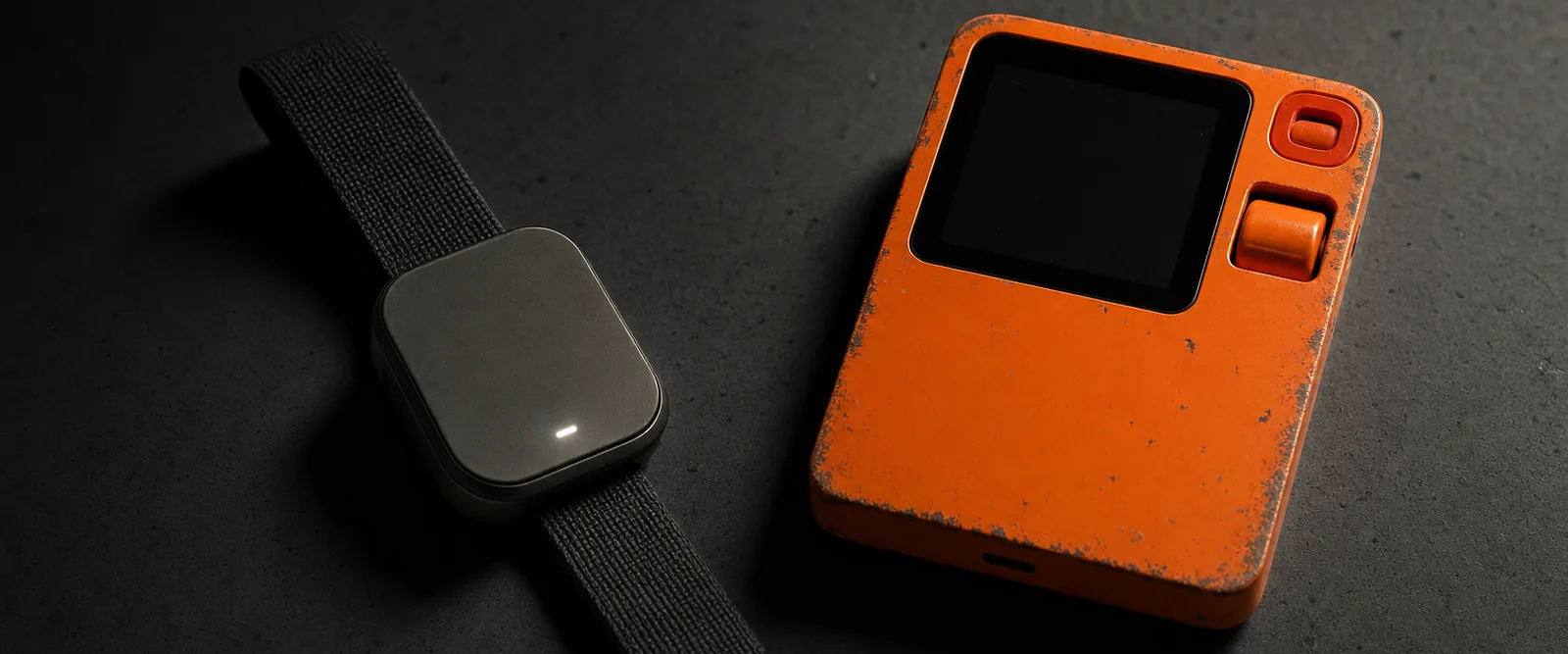
| Form factor | Magnetic chest-worn pin with laser projector | Handheld 3 x 3 x 0.5 in. orange device, 2.88-in. LCD screen |
| Voice / AI engine | None -- servers shut down Feb 28, 2025 | Perplexity AI + proprietary LAM + OpenClaw alpha (Jan 2026) |
| Battery | Was poor at launch; irrelevant -- device is non-functional | 1,000 mAh; approx. 12 hours moderate use (per Tom's Guide) |
| Connectivity | None (servers offline) | Wi-Fi; optional 4G LTE with SIM |
| Subscription | Was $24/month (now moot) | Free core tier; paid Intern tier from $30 |
| Current status | Discontinued / bricked | Active -- OTA updates through at least April 2026 |
| Best for | Nobody | Tech-curious AI experimenters |
Origin and Launch: Two Disasters, One Survivor
Both devices debuted to enormous hype and immediate disappointment. The Humane AI Pin launched in April 2024 after the company had raised more than $230 million, according to TechCrunch. It was designed by former Apple designers Imran Chaudhri and Bethany Bongiorno, worn on the chest as a magnetic pin, and priced at $699 plus a $24 monthly subscription. The pitch was ambitious: a voice-and-projection AI interface that could replace your smartphone. The reality, as documented by essentially every major reviewer, was a device that overheated during normal use, had battery life so short that Humane bundled extra battery packs in the box, and produced AI responses that were frequently wrong and painfully slow. YouTube reviewer Marques Brownlee called it "the worst product I've ever reviewed" -- a title he awarded before he even knew the company would fold within a year.
The Rabbit R1 also launched in April 2024, after generating enormous buzz at CES with a keynote demo that showed the device ordering Ubers, booking food, and controlling apps through natural language. At $199 it was cheaper and more approachable than the AI Pin. It was also, as The Verge's David Pierce wrote, "unfinished, unhelpful" -- a device whose headline Large Action Model barely functioned, whose camera misidentified objects consistently, and whose battery died in under two hours of active use. Tom's Guide gave it 1.5 out of 5 stars at launch. The company sold 130,000 units by mid-2024 despite the reviews, partly because a $199 price with no subscription is easy to justify as a curiosity buy.
The critical difference between the two companies was what happened next. Humane could not fix its fundamental problems -- overheating was a hardware issue, the laser projector was nearly useless in daylight, and the company was burning cash faster than it could attract subscribers. Rabbit, operating with cheaper hardware and simpler software, started shipping over-the-air updates every few weeks and kept at it for two full years. One company survived. The other did not.
AI Capabilities: One Has None, One Has Grown
There is no meaningful way to compare AI capabilities between these two devices in 2026, because the Humane AI Pin has none. When Humane's servers went dark on February 28, 2025, the device permanently lost voice commands, AI query responses, calling, messaging, and all cloud connectivity. The Verge confirmed the shutdown terms: no AI queries, no cloud access, no communication features. The only remaining function is displaying the battery level. That is it. A $699 device sold on the promise of replacing your phone can now tell you how charged it is.
The Rabbit R1, by contrast, has made meaningful progress. The Perplexity AI integration -- present from launch -- gives the device reliable real-time information for general queries. The LAM has been redirected from the overpromised autonomous app-navigation pitch toward a more practical "LAM Playground" that lets users train custom automations for specific websites and workflows. The Magic Camera's visual recognition has improved substantially from its dismal launch-day performance. By February 2025, Tom's Guide revisited the device and called it "actually good now" -- still not a smartphone replacement, but functional, often accurate, and genuinely fun to use.
The most significant development arrived in January 2026 when Rabbit shipped an OTA update adding OpenClaw integration in alpha. Yanko Design described it as potentially the R1's most important moment yet: OpenClaw is an open-source autonomous AI agent with over 60,000 GitHub stars that can browse the web, manage email, schedule meetings, and execute commands -- and the R1 now functions as a native voice interface for it. Users who set up their own OpenClaw gateway can issue voice commands through the R1 and have the agent act on them in real time. This is closer to the original vision of an AI assistant that acts on your behalf than anything either device shipped at launch. The integration is alpha-grade and requires technical setup, but it represents a genuine evolution of what the R1 can do. Rabbit followed with another OTA in April 2026 adding custom system prompts, improved battery management, and an expanded viewfinder for vision mode.
Hardware and Design
The Humane AI Pin was genuinely interesting hardware. The magnetic attachment system, the laser projector that turned your palm into a display, the built-in camera and speaker -- all of it came from designers who had spent years at Apple and it showed. The form factor was coherent with the product's screenless philosophy. The execution was not: the projector washed out in any ambient light, the palm interface was slow and error-prone, and the overheating issue was endemic. Reviewers universally reported that the device ran hot enough during normal use to be uncomfortable against clothing. None of this matters today because the hardware cannot be revived without Humane's servers, and Humane's servers are gone.
The Rabbit R1 is a small bright-orange handheld device measuring 3 x 3 x 0.5 inches, with a 2.88-inch LCD touchscreen, a rotating scroll wheel, and a motorized swivel camera that tilts forward for vision mode. It is a delightful physical object -- quirky, tactile, and immediately memorable. Unlike the AI Pin, the R1's hardware problems were always software problems in disguise: the scroll wheel felt sluggish because the firmware was sluggish, and both have improved with updates. The 1,000 mAh battery is still a limitation, and it always will be at that cell size. Tom's Guide's February 2025 retesting found roughly 12 hours of real-world battery life at moderate usage -- adequate but not generous.
Day-to-Day Usability
Day-to-day usability for the Humane AI Pin is zero. The device does not respond to voice. It does not connect to the internet. It cannot call anyone. You can press the side button and check the battery. That is the entire experience available to an AI Pin owner in 2026.
For the Rabbit R1, day-to-day usability in 2026 depends heavily on what you want from it. For voice-based AI queries, quick information lookups, and hands-free interaction, it works well and consistently. The Perplexity integration means answers are grounded in current information rather than training data cutoffs. Vision mode can identify objects, analyze scenes, and answer questions about what the camera sees. Multi-language support is in place. The r-cade gamification layer -- where interactions earn carrots that unlock cosmetic customizations -- is a minor thing that somehow makes the device more enjoyable to pick up. The LAM Playground automations require setup time but can yield genuinely useful shortcuts for frequent tasks. For the specific audience of technically engaged users who enjoy tinkering, the OpenClaw integration opens up real agentic possibilities. For everyone else, the honest answer is that your phone does all of this faster and better, and the R1's value is primarily in the dedicated, distraction-free experience it offers rather than any unique capability.
What Went Wrong with Humane
Almost everything. The AI Pin launched at $699 plus a $24 monthly subscription -- pricing that demanded near-flawless execution from a first-generation product. The AI responses were slow and frequently wrong. The laser projector was effectively unusable outdoors. The device overheated during normal use. Common tasks like calendar integration and to-do lists were not supported at launch. The company designed an independent device with its own phone number rather than an accessory to your existing phone, which meant it missed iMessage, WhatsApp, and virtually all group messaging. Reviewer after reviewer reached the same conclusion: the AI Pin was not a flawed version of the device Humane promised -- it was a fundamentally different and far lesser product.
The company reportedly processed more returns than actual sales at certain points, according to Wired. By May 2024, Humane was looking for a buyer. In February 2025, HP agreed to pay $116 million for the company's CosmOS software, patents, and technical staff -- but explicitly not the AI Pin hardware business, which was wound down. Servers went dark on February 28. Customers who bought the device more than 90 days before the announcement had no path to a refund. Some were left with hardware they could not return, missing charging cases from a prior recall that Humane never fulfilled, and a company that had ceased all customer service operations. It is one of the more complete hardware collapses in recent consumer tech history.
The broader lesson for anyone shopping in the AI wearable space -- and we cover this in depth in our analysis of AI wearables for 2026 -- is that cloud-dependent devices carry existential risk. If the company behind the device shuts down its servers, you own a very expensive piece of plastic.
What Is Working with Rabbit R1
Rabbit did not avoid the R1's terrible launch reviews. It shipped anyway, kept the price low, eliminated the subscription requirement for core features, and pushed updates relentlessly. Android Police noted in November 2025 that the company's pivot away from the broken assistant feature set toward agentic tools was the right move, even if it acknowledged the pivot came partly from necessity. The LAM Playground, Magic Camera improvements, voice customization, multi-language support, and the r-cade system all arrived after launch and all improved the product meaningfully.
The OpenClaw integration in January 2026 is the clearest signal that Rabbit is still genuinely trying. OpenClaw is an open-source agent with serious capability -- web browsing, email management, scheduling, shell command execution, persistent memory across sessions -- and the R1's combination of dedicated hardware, push-to-talk button, and voice interface makes it a natural physical front end for that kind of agentic work. The integration is early and requires technical setup, and Yanko Design flagged that over 400 malicious add-ons were found on the OpenClaw skill hub in early 2026 -- this is not something you deploy carelessly. But for users who are comfortable managing that complexity, the R1 finally offers a use case that feels native to its design. The April 2026 OTA added custom personality prompts, emailed Magic Photos, further battery optimizations, and an improved vision mode viewfinder, confirming the update cadence is still active.
Should Anyone Buy Either Today?
Buy the Rabbit R1 if...
- You want a dedicated, distraction-free AI interface and $199 is not a significant purchase for you
- You are interested in hands-on AI experimentation, including LAM Playground automations and OpenClaw agentic workflows
- You want no mandatory monthly subscription for core AI features
- You enjoy tinkering with a community-supported device that receives regular updates
- You want a unique, conversation-starting gadget with a real personality and gamification layer
Avoid the Humane AI Pin entirely if...
- You want a device that actually functions -- which is everyone
- You are tempted by the lower resale price on secondary markets (the device does nothing useful)
- You are a collector who wants a piece of tech history -- the shutdown was too ignominious to romanticize
- You were hoping HP would resurrect it -- HP bought the software and the patents, not the pin business
The Rabbit R1 is available from Amazon for $199 here. The Humane AI Pin is still listed on Amazon at $699 here -- we strongly advise against purchasing it. Any seller offering a "working" AI Pin is either misinformed or misleading you.
If you are considering the Rabbit R1, our full comparison page for these two devices has the side-by-side specification detail in one place.
Better Alternatives
If the idea of an AI companion device appeals to you but the R1's limitations give you pause, the Limitless Pendant at $99 is a sharper, more focused product: it excels at meeting transcription, note capture, and memory across your day, and it does those things reliably without asking you to manage agentic AI infrastructure. The Tab AI Necklace at $79 takes a similar ambient-capture approach. Both are covered in our roundup of the best AI pins and pendants for 2026, which is the best starting point if you are new to this category and trying to figure out what is actually worth buying.
For users who want AI assistance layered on top of hardware they already own, the Meta Ray-Ban Smart Glasses deliver a genuinely capable AI assistant -- with real-time visual context, natural voice interaction, and Meta AI integration -- in a form factor most people will actually wear every day. That product represents a more mature vision of what ambient AI hardware can be. You can explore the full landscape in our AI pins category or use our 2026 AI wearables buyer's guide to narrow down what fits your actual use case.
FAQ
Does the Humane AI Pin still work?
No. Humane shut down its servers on February 28, 2025, following HP's $116 million acquisition of the company's software assets. Every Humane AI Pin permanently lost its AI responses, voice commands, calling, messaging, and cloud access on that date. The device can still display its battery level -- that is the full extent of its remaining functionality. The Verge confirmed the shutdown terms: no AI queries, no cloud access, no communication features. It is a $699 brick.
Is the Rabbit R1 worth it in 2026?
For most people, no -- your smartphone does everything the R1 does, faster and more reliably. But at $199 with no mandatory subscription for core features, it has carved out a niche. If you are genuinely interested in hands-on AI experimentation, want a dedicated voice-first device, or want to explore agentic AI through the OpenClaw integration added in January 2026, the R1 has real things to offer. Casual users will find it redundant. Tom's Guide's 2025 revisit and Android Police's November 2025 piece both concluded it has earned a second look.
Can I get a refund for my Humane AI Pin?
Almost certainly not. Humane's refund window covered only customers who purchased within 90 days of February 27, 2025, with all requests required before that date. Fortune reported that early adopters were given no path to a refund and that customer service also shut down on February 28. If you purchased on a credit card, a chargeback dispute may have been possible shortly after the shutdown, but that window has almost certainly closed.
What did HP actually acquire from Humane?
HP paid $116 million for Humane's CosmOS operating system software, its intellectual property including more than 300 patents and patent applications, and most of Humane's technical employees. HP explicitly did not acquire the AI Pin hardware business, which was wound down entirely. Reuters reported that HP's goal was to integrate Humane's AI platform technology into its own products -- not to continue or revive the pin.
Does the Rabbit R1 require a monthly subscription?
Core features -- voice AI queries, Perplexity-powered search, Magic Camera, multi-language support, LAM Playground access, and the r-cade system -- are available without any subscription. Rabbit introduced an optional paid Intern tier for agentic task execution: three tasks cost $30, while 30 tasks per month cost $100 (or $840 per year). The free tier is substantive enough for most everyday use, and the subscription-free model remains one of the R1's clearest advantages over its competitors.
What is the Rabbit R1 Large Action Model and does it actually work?
The Large Action Model (LAM) was Rabbit's headline feature at CES: an AI system that could autonomously navigate apps and websites on your behalf. At launch it barely functioned. The Verge noted that the LAM appeared to be a web automation wrapper rather than a purpose-built model, and early integrations with Uber and DoorDash were unreliable. By 2025 Rabbit pivoted toward a user-trainable LAM Playground. It works, but it is slow. The January 2026 OpenClaw integration is the most credible expansion of the agentic vision to date, though it requires technical setup.
Are there better AI wearables than the Rabbit R1 available today?
Yes. The Limitless Pendant at $99 is sharper for meeting capture and memory. The Tab AI Necklace at $79 is the most affordable ambient AI option. For a dedicated AI assistant you will actually wear daily, the Meta Ray-Ban Smart Glasses are a more polished product at a higher price. Our roundup of the best AI pins and pendants for 2026 covers the full field with current prices and recommendations by use case.
Bottom Line
The Humane AI Pin is not a product you can buy in any meaningful sense -- it is non-functional hardware sold by third parties who either do not know or do not care that the servers are gone. Avoid it completely at any price. The Rabbit R1 is the survivor here, and it has earned that status through two years of consistent updates rather than through any initial quality. At $199 with no mandatory subscription, it is a defensible purchase for technically engaged users who want a dedicated AI experimentation device -- and the OpenClaw integration has given it more agentic capability than it has ever had. For everyone else, your phone remains the better tool, and the best AI pins of 2026 has more targeted recommendations for specific use cases. From my perspective as someone who has tracked both these products since their disastrous launch week, the Rabbit R1 story is actually a rare example of a company that refused to give up on a bad first impression -- and that counts for something even if the device is still not for everyone.
Products Covered
- Humane AI Pin — $699.00 by Humane
- Rabbit R1 — $199.00 by Rabbit
Amazon links are affiliate links (paid links). As an Amazon Associate we earn from qualifying purchases.
Frequently Asked Questions
Does the Humane AI Pin still work?
No. Humane shut down its servers on February 28, 2025, following HP's $116 million acquisition of the company's software assets. Every Humane AI Pin permanently lost its AI responses, voice commands, calling, messaging, and cloud access on that date. The device can still display its battery level -- that is the full extent of its remaining functionality. It is a $699 brick.
Is the Rabbit R1 worth it in 2026?
For most people, no. Your smartphone does everything the R1 does, better and faster. But at $199 with no subscription requirement for core features, it occupies a different category than it did at launch. If you are genuinely interested in hands-on AI experimentation, want a dedicated voice-first interface, or want to explore agentic AI through the OpenClaw integration added in January 2026, the R1 has real things to offer. Casual users will find it redundant.
Can I get a refund for my Humane AI Pin?
Almost certainly not. Humane's refund window was limited to customers who purchased within the 90 days prior to February 27, 2025. All refund requests had to be submitted by that date. Anyone who bought earlier, or who missed the window, has no recourse from Humane. If you purchased on a credit card, a chargeback dispute may have been possible shortly after the shutdown, but that window has likely passed as well.
What did HP actually acquire from Humane?
HP paid $116 million for Humane's CosmOS operating system software, its intellectual property including more than 300 patents, and most of Humane's technical employees. HP explicitly did not acquire the AI Pin hardware business, which was wound down entirely. HP's goal was to integrate Humane's AI platform technology into its own PC and printer software products.
Does the Rabbit R1 require a monthly subscription?
Core features -- voice AI, the Perplexity-powered search engine, Magic Camera, and multi-language support -- are available without a subscription. Rabbit introduced an optional paid tier for its Intern agentic features, which costs $30 for three tasks or $100 per month for 30 tasks. The free tier remains substantive enough for most everyday use.
What is the Rabbit R1 Large Action Model and does it actually work?
The Large Action Model (LAM) was Rabbit's headline feature at launch: an AI system that could autonomously navigate apps and websites on your behalf. At launch it barely functioned and critics noted it was essentially a web automation wrapper rather than a genuine AI model. By 2025 Rabbit pivoted toward a LAM Playground that lets users train custom automations. It works, but it is slow and requires setup. The January 2026 OpenClaw integration is the most meaningful expansion of that agentic vision yet.
Are there better AI wearables than the Rabbit R1 available today?
Yes, several. The Limitless Pendant at $99 focuses specifically on meeting transcription and memory, and does that job very well. For a broader view of what is available in the AI companion and AI pin category, our roundup of the best AI pins and pendants for 2026 covers the current field in detail.