XREAL Air 2 vs Rokid Max: Which AR Glasses Should You Actually Buy?
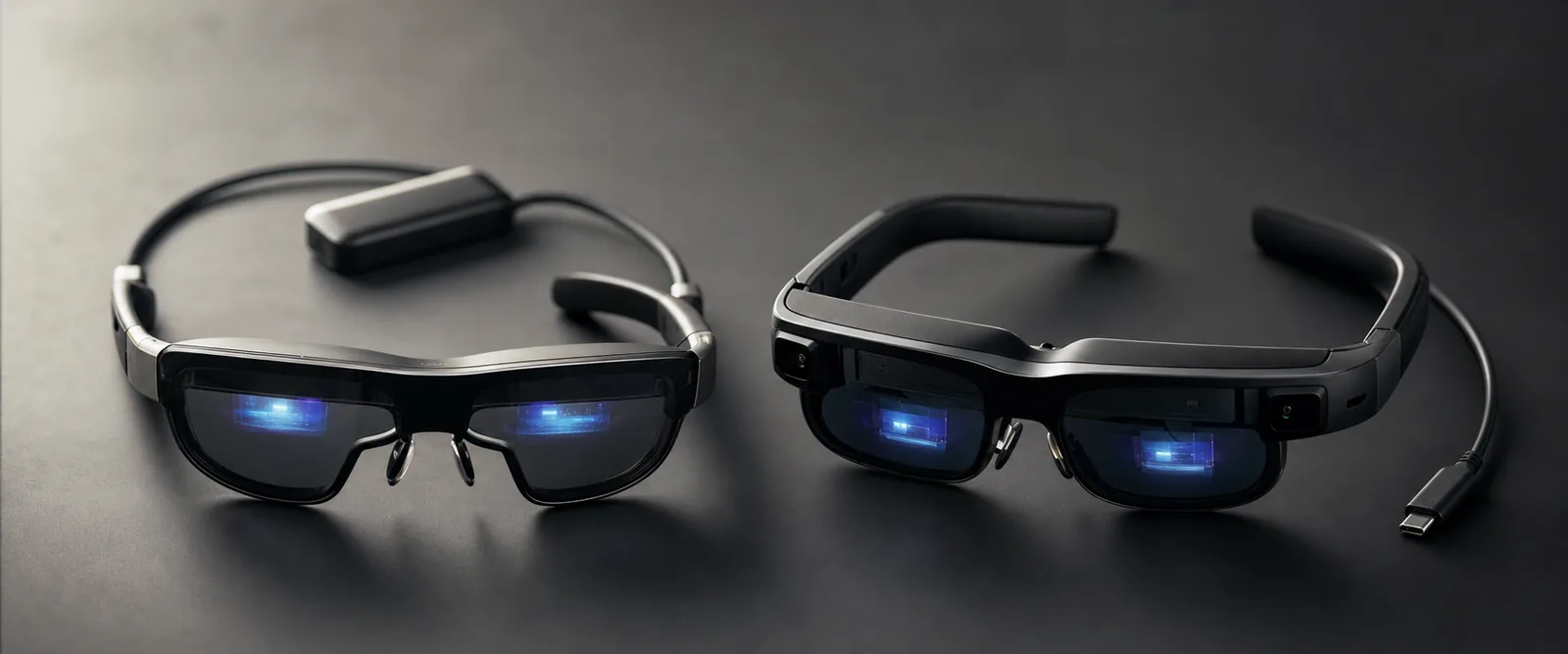
Two of the best tethered AR glasses go head-to-head. The XREAL Air 2 and Rokid Max share identical 1080p Micro-OLED panels but differ in brightness, field of view, built-in diopter adjustment, and ecosystem -- and the right choice depends entirely on how you plan to use them.
By AI Wearable Hub Editorial Team · Published
Affiliate Disclosure: AI Wearable Hub is reader-supported. We participate in the Amazon Associates program -- if you buy through links on this page, we may earn a commission at no extra cost to you. We research these products independently, and our editorial opinions are our own.
Quick Verdict
The Rokid Max is the better buy for most people: brighter at 600 nits, wider at 50 degrees FOV, equipped with built-in diopter correction up to -6.00D, and currently $42 cheaper at $407 on Amazon. The XREAL Air 2 justifies its $449 price for users who want the lightest tethered AR glasses available (72g vs 75g), plan to lean into XREAL's Nebula spatial computing software, or want to pair with the XREAL Beam accessory for a more flexible standalone setup. For pure movie watching, portable gaming, and prescription-free immersive display use, the Rokid Max wins on spec sheet and real-world brightness -- but the XREAL Air 2 is the right call if you are building a productivity-first AR workflow or are already invested in the XREAL ecosystem.
How We Evaluate AR Glasses
Tethered AR glasses live and die by three things: how good the display looks in real-world lighting, how comfortable they are to wear for more than 20 minutes, and which devices they actually work with. We weight display quality and compatibility the heaviest, because a wide compatibility list cannot rescue a dim or blurry image. We also factor in built-in convenience features -- like diopter adjustment -- that matter enormously to the majority of adults who wear corrective lenses, and audio, because both glasses double as speakers for movies and gaming.
Prices shown are sourced from Amazon at time of writing and update automatically when our price tracker detects changes. We never invent product specs or copy customer review text.
Specs at a Glance
| XREAL Air 2 | Rokid Max | |
|---|---|---|
| Price | $449 | $407 |
| Resolution (per eye) | 1920x1080 Micro-OLED | 1920x1080 Micro-OLED |
| FOV | 46 degrees | 50 degrees |
| Weight | 72g | 75g |
| Brightness | 500 nits | 600 nits |
| Refresh Rate | Up to 120Hz | 120Hz |
| Built-in Diopter | No (clip-in frame only) | 0.00D to -6.00D |
| Tracking | 3DoF | 3DoF |
| Audio | Dual open-ear, bass boost | HD Directional x2, AI mic |
| 2D/3D Mode | No | Yes |
| Best For | Productivity, XREAL ecosystem | Movies, gaming, myopia users |
Both glasses share a lot of DNA: 1080p Micro-OLED panels, USB-C-only connectivity, no onboard battery, and 3DoF head tracking. The differences are meaningful but not dramatic, which is exactly why picking the right one requires looking beyond the headline specs. You can see the full side-by-side breakdown at our XREAL Air 2 vs Rokid Max compare page.
Display Quality
On resolution alone, this is a dead heat. Both glasses project a 1920x1080 image per eye through birdbath Micro-OLED optics, and both deliver the kind of sharpness that makes individual pixels invisible at normal viewing distances. The GSMArena XREAL Air 2 review confirms the Air 2 uses Sony-made 0.55-inch panels with 49 pixels per degree, 108% sRGB coverage, and a deltaE 2000 value below 3 -- the kind of color accuracy numbers you see in calibrated monitors, not wearables. XREAL also individually calibrates each pair at the factory, which shows in the consistency of color from unit to unit.
Where the Rokid Max pulls ahead is brightness. The manufacturer specifies up to 600 nits of perceived brightness versus 500 nits for the XREAL Air 2, per the official Rokid Max spec page. That 100-nit gap is noticeable if you use these glasses anywhere other than a pitch-dark room. Both still struggle against strong ambient light -- neither can fully compete with a window behind you -- but the Rokid Max holds up better in office environments and dim sunrooms. Rokid also offers six brightness levels compared to a simple rocker switch on the XREAL Air 2, giving you finer control when you find the right setting for your environment.
Contrast is identical at 100,000:1, and color gamut nearly so: 108% sRGB on the Air 2 versus 106% on the Rokid Max -- imperceptible in use. The Rokid Max's native 2D/3D mode switching is a genuine advantage for 3D movie content; the XREAL Air 2 omits hardware-level 3D. Both are HDCP-compatible for DRM-protected streaming via wired display output.
Field of View and Immersion
Four degrees may not sound like much, but the jump from 46 degrees (XREAL Air 2) to 50 degrees (Rokid Max) is perceivable in real use, particularly when watching widescreen movies or playing open-world games. At 50 degrees, the Rokid Max presents a virtual screen equivalent to a 215-inch display viewed from 20 feet away, as Forbes noted in their Rokid Max review. The XREAL Air 2 projects a 130-inch effective screen at four meters in standard mode, which is still impressive but feels marginally less enveloping by comparison.
Edge blurriness is a shared limitation of birdbath optics at this price. Both glasses benefit from scaling the virtual screen to 80-105 percent of maximum, keeping the sharpest optics centered on your content. For a deeper look at this optical tradeoff, see our are AI wearables worth it in 2026 guide.
Both glasses use 3DoF tracking, which means the virtual screen floats in front of you and rotates as you move your head, but it does not stay locked to a fixed position in space as you physically move. For most media consumption and productivity use cases, 3DoF is fine -- the screen follows your gaze, which is what you want. If you need full 6DoF spatial computing (virtual objects anchored in real space as you walk around), you would need to step up to the XREAL Air 2 Ultra, which is a different product at a higher price point.
Comfort and Weight
The XREAL Air 2 is the lighter option at 72 grams, down from 79 grams on the original XREAL Air. XREAL redesigned the weight distribution for a 1:1 front-to-rear balance, which the GSMArena review notes reduces nose pressure noticeably compared to the predecessor. The zero-pressure nose pads are hollow-cushioned and softer than typical AR glass nose pieces, and the temples are ultra-soft with a 20-degree adjustable hinge. The Air 2 fits head widths from 120mm to 186mm with a 3-position vertical gaze adjustment.
The Rokid Max comes in at 75 grams, a three-gram difference that you would not notice in a blind test. Where it distinguishes itself is in prescription support: the built-in diopter adjustment dial corrects myopia from 0.00D to -6.00D without any additional accessories. This is a significant practical advantage for anyone who wears glasses or does not want to wear contacts for a two-hour movie. Users in the community consistently cite this as the Rokid Max's biggest single differentiator over the XREAL Air 2. With XREAL, you need to order a custom prescription insert separately -- adding cost and complexity. Both glasses include a light shield/blackout cover accessory for full immersion, and both support multiple nose pad sizes for different face shapes.
Extended wear comfort is comparable between the two. Both are light enough that most users report wearing them for 90 minutes to two hours without significant fatigue. The XREAL Air 2's slightly better weight distribution gives it a marginal edge in very long sessions, but neither is uncomfortable by AR glasses standards.
Audio
Both products use open-ear directional speakers built into the temples, and both produce audio quality that is genuinely good enough for movies and casual gaming -- a bar that many AR glasses fail to clear. The XREAL Air 2's second-generation speaker system includes dual open-ear drivers with two openings each and a bass boost tuning, plus dual omnidirectional MEMS microphones. Audio from the Air 2 is reasonably private: sound leakage is reduced compared to the original Air, though nearby listeners can still detect it at higher volumes, per the GSMArena assessment.
The Rokid Max has HD Directional speakers, dual noise-canceling microphones, and AI voice control. In practice, a community comparison found the Rokid Max leaks more audio to nearby people than the XREAL Air 2 -- a real consideration for open offices or planes. The XREAL Air 2 wins on audio privacy; for solo home use, both satisfy.
Compatibility
Both require USB-C DisplayPort Alt Mode for a direct wired connection. The XREAL Air 2 works out of the box with iPhone 15 series, Samsung Galaxy S22/S23 series, ASUS ROG Ally, Valve Steam Deck, M1/M2/M3 MacBooks, and Windows laptops with Thunderbolt or USB4, per the GSMArena deep-dive. For devices without DisplayPort, XREAL offers the Beam accessory ($119) or an HDMI adapter for consoles and the Nintendo Switch.
The Rokid Max requires USB-C 3.1 with DisplayPort support for direct connections -- compatible with modern Android flagships, USB-C iPads, USB-C iPhones (15 and newer), and USB-C laptops, per Rokid's compatibility documentation. For older iPhones, Rokid offers a wireless adapter. The Rokid Hub ($99) adds HDMI and pass-through charging, and the Rokid Station ($199) is an Android TV puck that makes the Max a self-contained entertainment system without a phone. Samsung connections automatically enter DeX mode. Neither glasses connects to the Nintendo Switch without an adapter, but both support it via HDMI accessories. Our best AI glasses of 2026 roundup maps the broader ecosystem; for pairing specifics, check our AI glasses category page.
Software and AI Features
The XREAL Air 2 has a more developed software ecosystem through the Nebula app, available for Android and Mac/Windows. Nebula provides a spatial display environment where you can pin multiple virtual screens in 3D space, manage workspace layouts, and access the Nebula for Android launcher. It is the foundation for XREAL's push toward spatial computing, and it integrates more cleanly with productivity workflows than Rokid's companion software. The tradeoff is that Nebula is primarily useful on phones with Snapdragon 845 or newer processors (some Exynos devices have limited support), and the app's stability has been an ongoing criticism in user communities -- rough edges remain as of late 2024.
The Rokid Max pairs with Rokid's companion app and, with the Rokid Station, runs Android TV for YouTube, Amazon Prime, and Disney+ (DRM caveats apply on some streaming modes). That interface is more approachable for non-technical users than XREAL's developer-oriented Nebula. The Max includes AI voice control via device assistants, though Rokid's AI features are less mature than dedicated AI glasses like the Meta Ray-Ban. Check for current deals on both models at our deals page, and if you are still figuring out the right category, our AR glasses quiz can help.
Value
At $407, the Rokid Max delivers more raw display performance per dollar: more brightness, wider FOV, native 2D/3D support, and built-in diopter adjustment -- all for $42 less than the XREAL Air 2. For a user who wants the best standalone AR display experience without additional accessories, the Rokid Max is the clear value winner. The XREAL Air 2 at $449 is not overpriced, but the premium over the Rokid Max requires justification from the software ecosystem, the lighter weight, or the XREAL Beam integration -- benefits that matter to a specific subset of users.
Accessory economics matter here. Nintendo Switch support requires a $30-100 HDMI adapter for both. A standalone experience adds $119 (XREAL Beam) or $199 (Rokid Station) -- the Station's Android TV is more streaming-friendly, the Beam is better for gaming. Both can push total cost well past $500. Our deals tracker monitors price drops on both models.
Choose XREAL Air 2 if...
- You want the lightest tethered AR glasses available (72g with optimized weight distribution)
- You plan to use Nebula for spatial productivity -- multiple pinned virtual screens, multi-window layouts on Android or Mac
- You already own or plan to buy the XREAL Beam for enhanced 3DoF tracking and standalone content playback
- You use a Steam Deck, ROG Ally, or other gaming handheld and want tight ecosystem support
- You do not need prescription correction and prioritize audio privacy in shared spaces
- You want the Sony Micro-OLED panel calibration quality and XREAL's color accuracy certification
Choose Rokid Max if...
- You wear glasses or have myopia up to -6.00D and want built-in diopter adjustment without separate inserts
- You primarily want the best display for movies, streaming, and console gaming at a lower price
- You watch 3D content and want hardware-level 2D/3D mode switching
- You need a brighter image (600 nits) for use in varied lighting conditions
- You plan to add the Rokid Station for a standalone Android TV experience
- You connect via Samsung DeX or want a wider virtual screen footprint (50-degree FOV)
FAQ
Can the XREAL Air 2 or Rokid Max connect to an iPhone?
The XREAL Air 2 works directly with the iPhone 15 series via USB-C DisplayPort. Earlier iPhones require an adapter. The Rokid Max connects to USB-C iPhones (iPhone 15 and later) directly; for older Lightning iPhones, Rokid offers a wireless adapter that casts over Wi-Fi, though latency is higher than a wired connection.
Do either of these glasses work with the Nintendo Switch?
Both work with the Nintendo Switch, but neither connects directly without an accessory. The XREAL Beam, XREAL Adapter, or a third-party HDMI-to-USB-C adapter bridges the gap for the Air 2. The Rokid Max similarly requires an HDMI adapter or the Rokid Hub ($99). User reports confirm the experience is excellent for portable gaming once the adapter is in place.
Do these AR glasses have a built-in battery?
Neither the XREAL Air 2 nor the Rokid Max has an internal battery. Both draw power entirely from the connected device via USB-C. This keeps weight low but means you are always tethered and the glasses will drain your phone or laptop battery while in use.
Which is better for watching movies -- XREAL Air 2 or Rokid Max?
The Rokid Max has a slight edge for movie watching: its 600-nit brightness and 50-degree FOV produce a more immersive, easier-to-see image, and it supports 2D/3D switching out of the box. The XREAL Air 2 is still excellent for movies and gains an edge if you add the XREAL Beam for a fixed, tracked screen, but the base glasses alone are dimmer and have a narrower field of view.
Can I use these glasses if I need prescription lenses?
The Rokid Max has a built-in diopter adjustment dial that corrects myopia from 0.00D to -6.00D without any add-ons -- a major practical advantage. The XREAL Air 2 ships with a separate prescription lens frame insert, but you need to order custom lenses from a third party. If you wear glasses or contacts, the Rokid Max's built-in correction is more convenient and less expensive.
What is the difference between 3DoF and 6DoF for these glasses?
Both the XREAL Air 2 and Rokid Max use 3DoF (three degrees of freedom) head tracking, meaning the virtual screen rotates with your head but is not anchored to a fixed point in physical space. This is fine for watching content and productivity. For true spatial AR -- where virtual objects stay locked to real-world positions as you walk around -- you would need the XREAL Air 2 Ultra, which adds 6DoF tracking.
Is the XREAL Air 2 or Rokid Max better for gaming?
For console gaming (Switch, Steam Deck, ROG Ally), both perform well at 120Hz. The XREAL Air 2 has a slight edge in gaming ecosystem depth thanks to Nebula's spatial display modes, and its 72g weight means less fatigue during long sessions. The Rokid Max counters with better brightness (less washout in varied lighting) and the wider 50-degree FOV that makes games feel more cinematic. Either is a strong choice -- pick based on your platform setup and whether you need the diopter adjustment.
Bottom Line
The Rokid Max is the right call for most buyers at $407: more brightness, wider field of view, built-in diopter correction, native 3D support, and a lower price than the XREAL Air 2. It is especially hard to beat if you wear corrective lenses. The XREAL Air 2 at $449 earns its place for users who want the most refined spatial computing software experience through Nebula, the lightest possible form factor, or tight integration with the XREAL accessory ecosystem. If you are still weighing your options across the full AR glasses market, our best AI smart glasses of 2026 guide covers the complete field. Across the tethered AR glasses our editorial team has reviewed over the past two years, the Rokid Max's built-in diopter adjustment alone has made it the recommendation we give most often to readers who ask which pair to buy -- because most adults are not wearing contacts all day, and the convenience of just dialing in your prescription is something you appreciate every single time you put them on.
Check the Rokid Max on Amazon | Check the XREAL Air 2 on Amazon
Products Covered
- XREAL Air 2 AR Glasses — $449.00 by XREAL
- Rokid Max AR Glasses — $407.54 by Rokid
Amazon links are affiliate links (paid links). As an Amazon Associate we earn from qualifying purchases.
Frequently Asked Questions
Can the XREAL Air 2 or Rokid Max connect to an iPhone?
The XREAL Air 2 works directly with the iPhone 15 series via USB-C DisplayPort. Earlier iPhones require an adapter. The Rokid Max connects to USB-C iPhones (iPhone 15 and later) directly; for older Lightning iPhones, Rokid offers a wireless adapter that casts over Wi-Fi, though latency is higher than a wired connection.
Do either of these glasses work with the Nintendo Switch?
Both work with the Nintendo Switch, but neither connects directly without an accessory. The XREAL Beam, XREAL Adapter, or a third-party HDMI-to-USB-C adapter bridges the gap for the Air 2. The Rokid Max similarly requires an HDMI adapter or the Rokid Hub ($99). User reports confirm the experience is excellent for portable gaming once the adapter is in place.
Do these AR glasses have a built-in battery?
Neither the XREAL Air 2 nor the Rokid Max has an internal battery. Both draw power entirely from the connected device via USB-C. This keeps weight low but means you are always tethered and the glasses will drain your phone or laptop battery while in use.
Which is better for watching movies -- XREAL Air 2 or Rokid Max?
The Rokid Max has a slight edge for movie watching: its 600-nit brightness and 50-degree FOV produce a more immersive, easier-to-see image, and it supports 2D/3D switching out of the box. The XREAL Air 2 is still excellent for movies and gains an edge if you add the XREAL Beam for a fixed, tracked screen, but the base glasses alone are dimmer and have a narrower field of view.
Can I use these glasses if I need prescription lenses?
The Rokid Max has a built-in diopter adjustment dial that corrects myopia from 0.00D to -6.00D without any add-ons -- a major practical advantage. The XREAL Air 2 ships with a separate prescription lens frame insert, but you need to order custom lenses from a third party. If you wear glasses or contacts, the Rokid Max's built-in correction is more convenient and less expensive.
What is the difference between 3DoF and 6DoF for these glasses?
Both the XREAL Air 2 and Rokid Max use 3DoF (three degrees of freedom) head tracking, meaning the virtual screen rotates with your head but is not anchored to a fixed point in physical space. This is fine for watching content and productivity. For true spatial AR -- where virtual objects stay locked to real-world positions as you walk around -- you would need the XREAL Air 2 Ultra, which adds 6DoF tracking.
Is the XREAL Air 2 or Rokid Max better for gaming?
For console gaming (Switch, Steam Deck, ROG Ally), both perform well at 120Hz. The XREAL Air 2 has a slight edge in gaming ecosystem depth thanks to Nebula's spatial display modes, and its 72g weight means less fatigue during long sessions. The Rokid Max counters with better brightness (less washout in varied lighting) and the wider 50-degree FOV that makes games feel more cinematic. Either is a strong choice -- pick based on your platform setup and whether you need the diopter adjustment.