How to Choose an AI Wearable in 2026: The Complete Buying Guide
Six categories, dozens of devices, and subscription costs nobody warns you about. This guide gives you a five-step framework to find the AI wearable that actually fits your life.
By AI Wearable Hub Editorial Team · Published
Affiliate Disclosure: AI Wearable Hub is reader-supported. We participate in the Amazon Associates program -- if you buy through links on this page, we may earn a commission at no extra cost to you. We research these products independently, and our editorial opinions are our own.
Quick Verdict
Start by matching the device category to your primary use case, not the other way around. Smart rings and health bands deliver the most consistent day-to-day value in 2026; AI glasses are the best bet for hands-free assistance; earbuds offer the lowest barrier to entry. Before buying anything, calculate the two-year total cost including subscriptions, confirm ecosystem compatibility with your phone, and check that the company behind the device has a realistic path to staying operational.
How We Evaluate AI Wearables
We assess AI wearables across eight criteria: ecosystem fit, subscription cost, battery life, comfort, AI quality, privacy posture, long-term support risk, and price-to-value. We weight AI quality and long-term support risk most heavily. Hardware specs matter less in this category than whether the software layer consistently delivers on its promise.
Prices shown are sourced from Amazon at time of writing and update automatically when our price tracker detects changes. We never invent product specs or copy customer review text.
What Counts as an AI Wearable
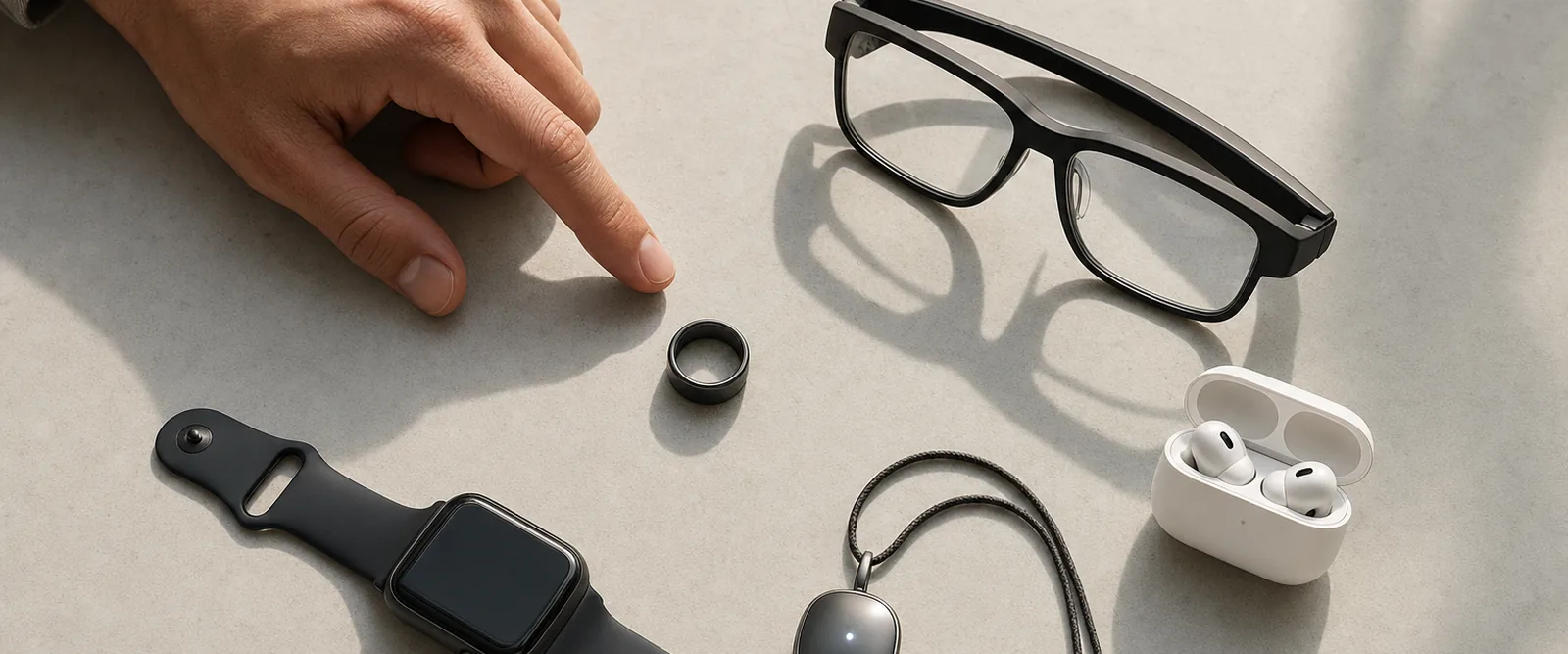
The term gets applied loosely. For this guide, an AI wearable is a body-worn device where AI meaningfully enhances what the hardware can do -- not just a device with Bluetooth and an app. Six categories qualify in 2026.
AI Glasses -- frames with embedded microphones, speakers, and sometimes cameras for hands-free AI interaction, or AR-display glasses that project a screen in your line of sight. See our AI glasses category for ranked picks.
Smart Rings -- slim finger-worn sensors tracking sleep, heart rate, HRV, blood oxygen, and body temperature continuously. The AI in the companion app synthesizes raw biometrics into readiness scores and trend analysis. Browse the smart rings category for a full comparison.
AI Earbuds -- premium wireless earbuds where the AI layer handles real-time translation, adaptive noise cancellation, and voice assistant integration that goes beyond simple commands. Not every pair qualifies; the AI has to do real work. See AI earbuds for our picks.
Health Wearables -- wristbands and trackers where AI processes continuous biometric streams into health coaching, recovery scoring, and anomaly alerts. The health wearables category covers options from Whoop to Fitbit to Withings.
AI Pins and Pendants -- clip-on or around-the-neck devices designed for meeting capture and ambient AI assistance. The category is still early-stage. Explore current options in the AI pins category.
Smart Watches -- wrist computers where AI powers health anomaly detection, workout coaching, and voice assistant responses. Apple Watch, Samsung Galaxy Watch, Garmin, and Google Pixel Watch all qualify. See the smart watches category for complete coverage.
Who Should Buy Each Type
The category that fits you best depends almost entirely on your dominant use case. Here is how we map use cases to form factors.
Hands-free capture and ambient AI assistance: AI glasses are purpose-built for this. Meta Ray-Ban Smart Glasses are the most practical option today -- they look like regular frames, battery handles a full day of moderate use, and Meta AI covers a broad range of queries. Our AI glasses roundup covers the full field.
Productivity and meeting capture: AI pins and pendants target this use case directly. The Limitless Pendant is the most affordable entry point, focused on meeting summarization and recall. If you spend most of your workday in calls, a pendant that captures and transcribes context can have real ROI. Social norms around ambient recording are still forming, so be transparent with participants.
Fitness and recovery optimization: Whoop 4.0 is purpose-built for athletes tracking strain and recovery in detail. For less intensive use, the Fitbit Charge 6 or Garmin Vivosmart 5 offer solid coaching without a premium subscription. Our best health wearables for fitness article covers this segment in full.
Sleep tracking without a wristband: Smart rings are designed to be worn all night comfortably. Oura Ring Gen 3 is the benchmark; its sleep staging and HRV data feed into a morning readiness score most users find genuinely useful.
Everyday ambient assistant: AI earbuds are the lowest-friction entry point -- you are already wearing them. Upgrading to a pair with real AI integration adds translation, smarter ANC, and reliable voice assistance. AirPods Pro 2 is the natural choice for iPhone users; our earbuds roundup covers the best Android options.
Buying Criteria
Work through these criteria in order. The first two eliminate devices before you reach the features comparison.
- Ecosystem fit (iOS / Android / agnostic): This is the single most important filter. Apple Watch requires an iPhone -- it will not pair with Android at all. Samsung Galaxy Watch works with any Android phone but loses Samsung Health features outside the Galaxy ecosystem. Devices that are genuinely agnostic -- Oura Ring, Garmin, Whoop, RingConn, Limitless -- work with either platform and protect your investment if you switch phones. Check the manufacturer's compatibility page before you add anything to your cart.
- Subscription costs: The sticker price is frequently the smaller number. Oura Ring Gen 3 costs $339 upfront plus $5.99 per month, bringing the two-year total to roughly $483. Whoop 4.0 runs around $239 per year -- $478 over two years. Apple Watch Series 10, Garmin Venu 3, and Samsung Galaxy Ring carry no mandatory subscription for core features. Always compute the two-year total before comparing prices. Our deals tracker flags when hardware prices drop.
- Battery life and daily-charge tolerance: If you want overnight sleep tracking, you need a charging window outside your eight hours. Garmin watches and the RingConn Smart Ring offer multi-day battery that creates scheduling flexibility. Apple Watch Ultra 2 reaches up to 60 hours per manufacturer specs, a meaningful lead over standard Apple Watch models.
- Comfort and wearability: A wearable you leave on the nightstand collects no data. Rings fit most people well but sizing is non-trivial -- order a sizing kit before committing. AR display glasses are session-use devices for most people, not all-day wear. Earbuds vary widely in fit; no AI feature compensates for a tip that does not seal properly.
- AI quality: Ask what the AI does that your phone cannot do as conveniently. Meta Ray-Ban glasses give you a hands-free assistant that sees what you see -- genuinely additive. A smartwatch that surfaces step data in a chatbot interface is not meaningfully different from a standard app. The AI must reduce friction or surface insights that would not otherwise reach you.
- Privacy posture: Always-on microphones and cameras create real exposure. Before purchasing, confirm where data is stored, whether recordings are processed on-device or in the cloud, and how deletion works. Glasses and pins carry the highest social risk; people nearby may not consent to being recorded. Rings and health bands are private by design.
- Long-term support risk: In February 2025, Humane shut down the AI Pin service less than a year after shipping, leaving customers with non-functional $700 devices after HP acquired the company's software assets. Reuters reported the $116 million deal did not include the hardware. Prefer established brands or devices that retain core offline functionality if servers go dark.
- Price-to-value: The most useful AI wearable is almost never the most expensive one. The Google Pixel Buds Pro 2 at $169 delivers more practical daily AI value for most Android users than a $699 AI pin. Map price against how many hours per day you will actually use the AI features.
Not sure where to start? Try our AI wearable quiz for a personalized recommendation, or use the compare tool to run any two devices head-to-head.
Recommendations by Use Case
These are our strongest picks from the current catalog, organized by what you want to do rather than by device category.
If you want hands-free photo capture and AI assistance: Meta Ray-Ban Smart Glasses (2nd Gen), currently $379 on Amazon. These are the AI glasses that proved the category can work for normal daily wear. The frames look like standard Ray-Bans, the Meta AI assistant handles navigation, translation, and contextual queries, and the camera is useful enough for spontaneous shots without pulling out a phone. They are an early-adopter product, not a finished platform, but they are the most practical AI glasses available today. Read our AI glasses roundup for alternatives.
If you want sleep insights without a wristband: Oura Ring Gen 3, currently $339 on Amazon. It tracks sleep stages, HRV, respiratory rate, and body temperature through the night, synthesizing them into a morning readiness score. The Oura Advisor chatbot now fields health questions with context from your own data. The $5.99 monthly subscription is required for AI features. Compare it against the Samsung Galaxy Ring at our Oura vs Galaxy Ring comparison.
If you want AI in your ears with the lowest friction: Apple AirPods Pro 2 (USB-C), currently $258 on Amazon for iPhone users. They deliver the most polished AI earbud experience in the iOS ecosystem -- adaptive noise cancellation, reliable Siri integration, and on-device voice processing. Android users should consider the Google Pixel Buds Pro 2 at $169 for real-time translation and Gemini integration. See the AI earbuds for translation roundup for a full comparison.
If you want meeting capture and AI memory: Limitless Pendant, currently $99 on Amazon. Its focus on meeting summarization and recall is the most practical use case the AI pin category currently offers. Treat it as a dedicated capture device for work conversations, not a phone replacement. The lower price point reduces your exposure to the long-term support risk inherent in the category.
If you want serious fitness and recovery tracking: Whoop 4.0, currently $239 on Amazon. Whoop bundles hardware and subscription together and focuses on the relationship between sleep, recovery, and training load. Its AI synthesizes daily strain and recovery scores that serious athletes find actionable for pacing their training. No screen keeps it minimal; the all-in subscription means no surprise hardware costs, but the device is tied to the service.
If you want the most capable AI smartwatch: Apple Watch Ultra 2, currently $569 on Amazon for iPhone users. It pairs Apple's most mature health AI -- irregular rhythm notifications, crash detection, temperature-based cycle tracking -- with up to 60 hours of battery life per manufacturer specs. It is significantly more expensive than the Apple Watch Series 10 and overkill for casual users; read our Ultra 2 vs Galaxy Watch 6 comparison before deciding.
Common Pitfalls
These are the four mistakes we see most often from first-time AI wearable buyers.
Overpaying for an AI label on otherwise ordinary hardware. Some devices charge a significant premium for a feature set that amounts to a renamed dashboard with a chatbot bolted on. Before buying, ask: what does the AI do that a standard tracker does not? If the answer is vague, the AI is a marketing label. Check reviews from The Verge, CNET, or Wired before committing.
Ignoring subscription cost until after purchase. A device listed at $299 can cost $583 over two years once the subscription is included. We cover two-year cost breakdowns in our are AI wearables worth it article. Check our deals page for current hardware discounts.
Ecosystem lock-in surprise. Apple Watch will not pair with Android phones. Some Samsung Health features are unavailable outside the Galaxy ecosystem. Read the full compatibility requirements on the manufacturer's page -- not just the box summary -- before buying.
Buying from a company with uncertain server longevity. The Humane AI Pin shutdown in early 2025 demonstrated that when a cloud-dependent AI wearable company closes, the device stops working. This risk is highest with early-stage startups. If you buy into the AI pin category, price that risk accordingly. Axios covered the Humane shutdown in full; read it before buying any unproven AI hardware.
FAQ
What is the best AI wearable for beginners in 2026?
For most people, an AI earbud upgrade is the safest first step. AirPods Pro 2 (iPhone) and Google Pixel Buds Pro 2 (Android) deliver real AI utility through translation, adaptive noise cancellation, and voice assistance -- no subscription required. If you want health data, the Oura Ring Gen 3 is the most mature smart ring platform, though it charges a monthly fee for AI insights.
Do AI wearables require a subscription?
Many do. Oura Ring charges $5.99 per month for AI insights. Whoop bundles the device with a subscription at around $239 per year. Apple Watch, Garmin, and most AI glasses require no subscription for core features. Always calculate the two-year total before comparing prices.
Are AI glasses ready for everyday use in 2026?
Meta Ray-Ban Smart Glasses are genuinely wearable every day -- they look like normal frames and Meta AI handles real queries competently. AR display glasses like the XREAL Air 2 are more niche; they work well as portable screens but are bulkier and less suited for all-day wear. As The Verge reported, 2025 was a pivotal year for AI glasses, with Meta reframing the category around constant AI access.
What happened to the Humane AI Pin?
Humane shut down the AI Pin service on February 28, 2025, just under a year after the device started shipping. HP acquired Humane's software assets for $116 million, but the hardware was discontinued entirely. Devices that could not be refunded became non-functional. Mashable noted that only customers who had owned the device for fewer than 90 days were eligible for refunds. This is the clearest recent example of server-shutdown risk in AI wearables.
Which AI wearable is best for sleep tracking?
The Oura Ring Gen 3 is the benchmark for wristband-free sleep tracking. It tracks sleep stages, HRV, respiratory rate, and body temperature, synthesizing them into a morning readiness score. Whoop 4.0 is a strong alternative for athletes who want sleep data tied directly to training load, though it requires both a wristband and a subscription.
Is there an AI wearable that works without a smartphone?
Most require a paired phone for full functionality. Apple Watch Ultra 2 has cellular connectivity for calls, maps, and Siri independently, but works best alongside an iPhone. AI pins like the Limitless Pendant are companion devices, not phone replacements. The Humane AI Pin tried the fully standalone approach -- and has since been discontinued.
How do I avoid ecosystem lock-in with AI wearables?
Check the device's official compatibility page, not just the retailer's summary. Apple Watch requires an iPhone. Samsung Galaxy Watch loses some Samsung Health features outside the Galaxy ecosystem. Oura Ring, Whoop, Garmin, and RingConn work with both iOS and Android. Use our compatibility quiz to verify your specific setup before buying.
Bottom Line
The AI wearable market in 2026 has real products that deliver real value, but the category rewards deliberate buyers and punishes impulsive ones. Match the device type to your dominant use case first, then filter by ecosystem compatibility and two-year total cost. For most people, the right first AI wearable is either an earbud upgrade (lowest friction, no subscription) or a smart ring (passive health insights, comfortable all-day wear). Save the AI glasses and pins for when you have a specific use case that justifies the complexity and the risk. If you are still deciding, start with our personalized quiz or browse all current hardware deals at /deals. As your lead editor, I find that the buyers who are happiest six months in are the ones who asked "what will I actually use this for every day" before they asked "what is the most impressive thing this can do."
Products Covered
- Meta Ray-Ban Smart Glasses (2nd Gen) — $379.00 by Meta
- Oura Ring Gen 3 — $339.00 by Oura
- Apple AirPods Pro 2 (USB-C) — $258.21 by Apple
- Whoop 4.0 — $239.00 by Whoop
- Limitless Pendant — $99.00 by Limitless
- Apple Watch Ultra 2 — $569.32 by Apple
Amazon links are affiliate links (paid links). As an Amazon Associate we earn from qualifying purchases.
Frequently Asked Questions
What is the best AI wearable for beginners in 2026?
For most people, an AI earbud upgrade is the safest first step. The Apple AirPods Pro 2 (for iPhone users) and the Google Pixel Buds Pro 2 (for Android users) deliver real AI utility through translation, adaptive noise cancellation, and voice assistance, with no subscription required. If you want health data, the Oura Ring Gen 3 is the most mature smart ring platform, though it does charge a monthly fee.
Do AI wearables require a subscription?
Many do, and subscription costs often exceed the hardware cost over two years. Oura Ring requires $5.99 per month for its AI health insights. Whoop bundles the subscription with the device at around $239 per year. Apple Watch, Garmin, and most AI glasses do not require a subscription for core features. Always calculate the two-year total before purchasing.
Are AI glasses ready for everyday use in 2026?
Meta Ray-Ban Smart Glasses (2nd Gen) are genuinely wearable every day because they look like normal glasses and the AI assistant handles real queries competently. AR display glasses like the XREAL Air 2 and Rokid Max are more niche -- they work well as portable screens but are bulkier and less suited for all-day outdoor wear. According to The Verge, 2025 was a pivotal year for AI glasses, with Meta reframing the category around constant AI access rather than pure display functionality.
What happened to the Humane AI Pin?
Humane shut down the AI Pin service on February 28, 2025, just under a year after the device started shipping. HP acquired Humane's software assets for $116 million, but the hardware was discontinued entirely. Devices that could not be refunded became non-functional. This is the clearest recent example of server-shutdown risk in AI wearables -- when a startup's cloud goes offline, so does the product.
Which AI wearable is best for sleep tracking?
The Oura Ring Gen 3 remains the benchmark for sleep tracking without a wristband. It tracks sleep stages, HRV, respiratory rate, and body temperature, and its AI synthesizes those signals into a readiness score each morning. The Whoop 4.0 is a strong alternative for athletes who want sleep data tied tightly to training load, though it requires a wristband and a subscription.
Is there an AI wearable that works without a smartphone?
Most AI wearables rely on a paired smartphone for full functionality. The Apple Watch Ultra 2 has cellular capability and can handle calls, maps, and Siri independently, but it still works best alongside an iPhone. AI pins like the Limitless Pendant are designed for smartphone-companion use rather than replacement. The Humane AI Pin tried to be fully standalone but that product has been discontinued.
How do I avoid ecosystem lock-in with AI wearables?
Before buying, check the device's official compatibility list. Apple Watch requires an iPhone. Samsung Galaxy Watch works best with a Galaxy Android phone. Oura Ring, Whoop, Garmin, and RingConn are ecosystem-agnostic and work with both iOS and Android. If you switch phone platforms in the future, ecosystem-agnostic devices protect your investment. Use our compatibility quiz at /quiz to check your specific setup.