Oura Ring vs Whoop vs Fitbit Charge 6: Which Recovery Tracker Wins in 2026?
Three very different approaches to recovery tracking, one buying decision. We break down how the Oura Ring Gen 3, Whoop 4.0, and Fitbit Charge 6 compare on sleep depth, HRV science, form factor, and long-term cost.
By AI Wearable Hub Editorial Team · Published
Affiliate Disclosure: AI Wearable Hub is reader-supported. We participate in the Amazon Associates program -- if you buy through links on this page, we may earn a commission at no extra cost to you. We research these products independently, and our editorial opinions are our own.
Quick Verdict
For sleep obsessives and recovery nerds, the Oura Ring Gen 3 is the standout pick -- its finger-based sensors, seven temperature sensors, and best-in-class sleep staging make it the most insightful tracker of the three, and the $5.99/month subscription is the least painful of the bunch. Serious athletes who want continuous strain monitoring and can live without a screen should choose the Whoop 4.0 -- its recovery framework is genuinely unmatched for training-load management, though the $30/month membership fee adds up fast. If you want capable, display-equipped tracking without a mandatory subscription, the Fitbit Charge 6 at $159 is the clear value play, with built-in GPS and solid sleep metrics that most casual users will never outgrow.
How We Evaluate Recovery Trackers
We assess recovery trackers on five dimensions that matter for day-to-day use: sleep tracking accuracy and depth, HRV and recovery score methodology, form factor and 24/7 wearability, activity tracking capability, and total cost of ownership over two years (not just the sticker price). For this comparison, we weighted sleep and HRV quality most heavily, since all three devices pitch themselves primarily as recovery tools rather than GPS sports watches. We also looked hard at subscription economics -- because a cheap device with a steep monthly fee is not actually a budget buy.
Prices shown are sourced from Amazon at time of writing and update automatically when our price tracker detects changes. We never invent product specs or copy customer review text.
Spec Comparison
| Oura Ring Gen 3 | Whoop 4.0 | Fitbit Charge 6 | |
|---|---|---|---|
| Price (device) | $339 | $239 (includes 12-mo membership) | $159 |
| Subscription | $5.99/mo or $69.99/yr | $30/mo or $239/yr | None required ($9.99/mo Premium optional) |
| Year-1 cost | ~$411 (device + 12-mo sub) | $239 (device+sub bundled) | $159 (or ~$239 with Premium) |
| Year-2 cost | ~$72/yr sub | ~$239/yr sub | $0 (or ~$80/yr Premium) |
| Form factor | Ring (titanium) | Wristband (no screen) | Wristband (AMOLED display) |
| Battery life | Up to 7 days (4-5 days with SpO2) | 4-5 days | Up to 7 days |
| Water resistance | 100m | 10m | 50m |
| Sleep tracking | Best-in-class (stages, SpO2, HRV, temperature) | Advanced (stages, respiratory rate, HRV) | Good (stages, SpO2, skin temp) |
| HRV tracking | Nightly (during sleep) | Continuous (24/7) | Via stress management score |
| GPS | No (phone GPS only) | No (phone GPS only) | Yes (built-in) |
| Display | None | None | 1.04-inch AMOLED |
| Best for | Sleep nerds, recovery-focused users | Athletes, serious fitness training | General fitness, casual users |
Form Factor and Wearability
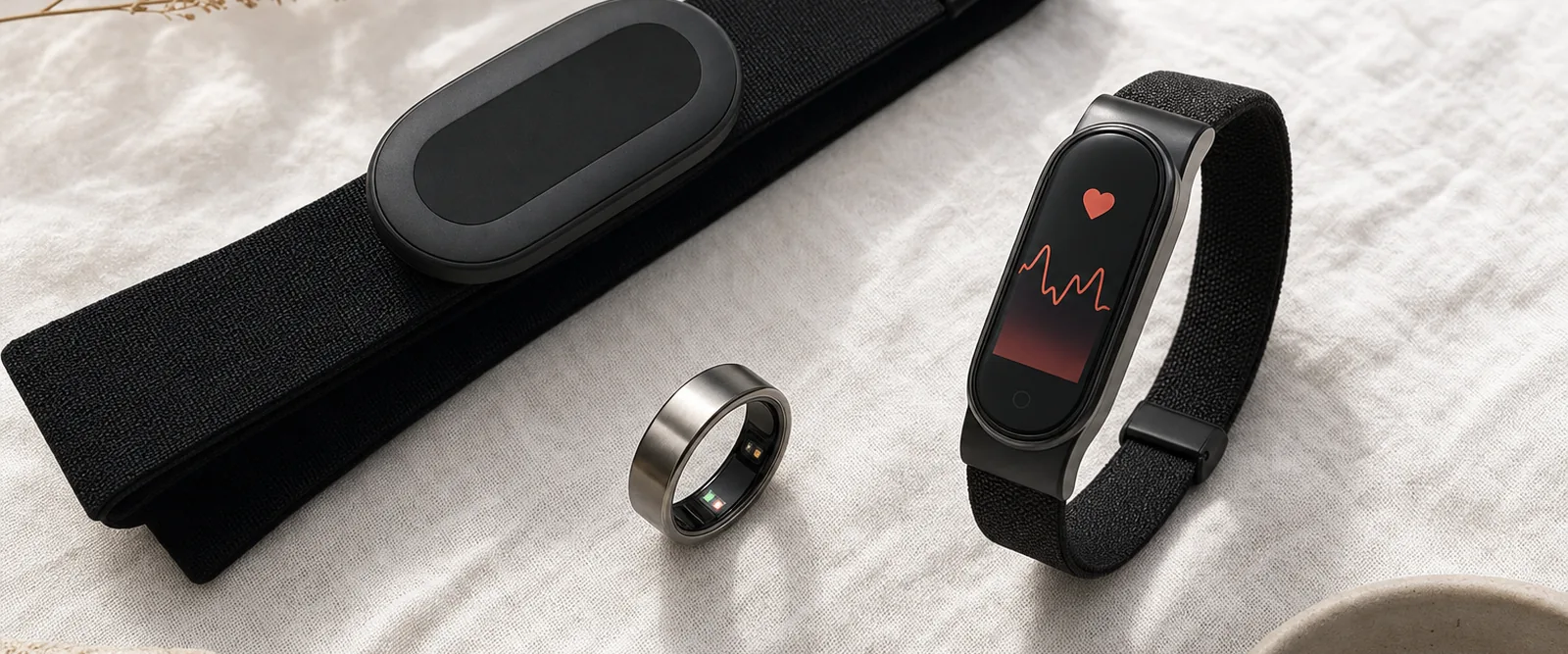
These three trackers take completely different physical approaches, and that difference shapes how useful each one is in practice. The Oura Ring Gen 3 is a titanium ring -- currently $339 on Amazon -- that you wear on your finger like any other piece of jewelry. It comes in Heritage (flat-topped) and Horizon (rounded) styles and six finishes including stealth and gold. Because it sits on your finger, it is invisible under gloves, never interferes with a watch, and does not look out of place at a board meeting or a wedding. The tradeoff is sizing: Oura uses a free sizing kit that takes two to seven days to ship, and you need to wear the plastic test ring for at least a day before ordering, as the Verge noted in its long-term review. If your fingers swell in the heat or shrink in the cold, fit can become an ongoing nuisance.
The Whoop 4.0 is a screenless, rectangular sensor pod that clips into interchangeable fabric bands. At 1.5 x 1 x 0.5 inches and roughly 30% smaller than the Whoop 3.0, it sits flush on the wrist without the bulk of a smartwatch, as Tom's Guide documented in its review. The real wearability advantage is Whoop Body -- a line of compression garments with built-in sensor pockets that let you move the tracker to your bicep, calf, or chest. For contact sports or weightlifting where wrist wear is a problem, that flexibility is a genuine differentiator. The charger clips onto the band so you can top up the battery mid-day without taking the device off, which means you can theoretically achieve 24/7 uninterrupted data capture.
The Fitbit Charge 6 is the most conventional of the three: a wristband tracker with a 1.04-inch AMOLED display and a physical side button, currently $159 on Amazon. It is slim enough to sleep in comfortably, and the display means you can actually glance at your heart rate or step count without pulling out your phone -- something neither the Oura nor the Whoop can do. If you are coming from a smartwatch, the lack of screen on the other two will feel like a significant step backward. For users who want at-a-glance awareness plus a wrist tracker they can wear to the office without explaining what a WHOOP is, the Charge 6 is the obvious pick. Browse the full health wearables category if you want to compare it against alternatives like the Garmin Vivosmart 5.
Sleep Tracking Depth
Sleep is where these three products diverge most sharply, and it is where the Oura Ring Gen 3 earns its premium. Oura uses seven temperature sensors (four more than the Gen 2), green and infrared LEDs for heart rate, a SpO2 sensor, and an accelerometer, all positioned on the finger where arteries are relatively close to the skin surface and ambient temperature fluctuations have less impact on readings. In a 2024 validation study by Robbins et al., the Oura Ring Gen 3 achieved a Cohen's kappa of 0.65 for four-stage sleep classification against polysomnography -- outperforming both the Fitbit Sense 2 (kappa 0.55) and Apple Watch Series 8 (kappa 0.60), as summarized in an academic accuracy review circulated in the Oura community. In practical terms, we found the ring accurately captured subtle detail -- wake events, REM onset timing, and temperature dips during deep sleep -- that wrist trackers routinely miss. The app organizes this into a Sleep Score built from total sleep, HRV, nighttime movement, and sleep regularity, and a Readiness Score that synthesizes overnight data with strain trends to tell you how hard you can push today.
The Whoop 4.0 punches above its weight on sleep tracking for an athletic audience. Its Sleep Coach sets a personalized sleep-need target based on recent strain, then tracks time in bed, sleep efficiency, stages, respiratory rate, and HRV in service of a single Recovery score delivered each morning. In the 2025 Antwerp laboratory study cited in that same accuracy review, Whoop led all tested devices in deep sleep detection sensitivity (69.6%), ahead of Apple Watch (50.7%) and Fitbit Sense (48.3%) -- a meaningful finding for anyone using the tracker to optimize recovery from hard training. The one quirk: Whoop calibrates its overnight data after about 15-20 minutes of morning movement, so your recovery score will not appear the moment you wake up, as Tom's Guide observed.
The Fitbit Charge 6 delivers sleep tracking that is genuinely good for its price point. It captures light, deep, and REM stages, skin temperature variation, and SpO2 nightly averages, and in a side-by-side comparison by Tom's Guide, its sleep stage readings were within a few minutes of Oura Ring figures on the same nights. The catch is that the detailed stage breakdown and a meaningful sleep score require Fitbit Premium ($9.99/month after the six-month trial included with purchase). Independent EEG validation found Charge 6 improved on prior models, with awake detection accuracy jumping to roughly 75% -- leading the field among non-EEG wearables in that particular analysis. For casual users who want to understand broad sleep trends, the free tier is enough; sleep researchers will find the Oura meaningfully more granular. If you want deeper context on sleep-focused wearables, our best health wearables guide covers several more options.
HRV and Recovery Science
Heart rate variability is the central metric that all three trackers use to quantify recovery, but each takes a philosophically different approach. The Whoop 4.0 tracks HRV continuously around the clock, capturing RMSSD (root mean square of successive differences) -- the specific HRV metric most sensitive to the parasympathetic nervous system and considered the gold standard for recovery monitoring in sports science, as Body Science Review detailed in its 2026 analysis. Whoop then synthesizes HRV with resting heart rate, sleep performance, and respiratory rate into a daily Recovery score expressed as a percentage (0-100%). A green score (67-100%) suggests high readiness; yellow (34-66%) signals caution; red (0-33%) indicates the body needs rest. The strain tracking framework -- a logarithmic 0-21 scale driven by heart rate data -- rounds out the picture by quantifying how hard you actually worked and comparing that against your recovery capacity.
The Oura Ring Gen 3 measures HRV nightly rather than continuously. Its advantage is sensor position: the finger contains the radial and digital arteries, producing a cleaner signal with fewer motion artifacts than a wrist sensor during sleep. In independent accuracy testing comparing devices against chest-strap ECG references, Oura Gen 3 achieved a concordance correlation coefficient of 0.97 for resting heart rate and a mean absolute percentage error of 7.15% for nocturnal HRV -- strong figures for a consumer ring, as documented in the same academic accuracy summary referenced earlier. Oura folds HRV, skin temperature, and sleep data into its Readiness Score (0-100), and adds long-term metrics like HRV balance (your current HRV versus your 3-month baseline) and recovery index (how quickly your resting heart rate stabilizes mid-sleep). For users interested in tracking reproductive health alongside recovery, Oura also uses temperature trends for cycle tracking with FDA-cleared Natural Cycles integration -- a capability the other two lack entirely. You can compare Oura against other ring options in our best smart rings guide and our dedicated Oura Ring vs Samsung Galaxy Ring comparison.
The Fitbit Charge 6 uses HRV as one input into its Stress Management Score (0-100), which blends responsiveness metrics (HRV, resting heart rate), exertion data (steps, activity norms), and sleep quality into a single readiness proxy. It is useful directionally but is not the same granular HRV methodology that Oura and Whoop offer. For competitive athletes who want to optimize training loads, Fitbit's approach is too simplified. For someone who wants a general health pulse without spending $30/month, it is perfectly adequate. The Daily Readiness Score -- a more direct readiness signal -- is gated behind Fitbit Premium, which is worth noting.
Activity Tracking
This is the one category where the Fitbit Charge 6 leads outright. It is the only device of the three with built-in GPS, and while The Verge's Fitbit Charge 6 review noted that GPS accuracy in difficult signal conditions is not Garmin-level, it is entirely adequate for most runners and cyclists who want accurate route maps and pace data without carrying a phone. The Charge 6 also supports 40+ exercise modes, can broadcast heart rate via Bluetooth to Peloton, NordicTrack, Concept2, and Tonal machines, and features Google Maps and Google Wallet integration -- practical additions that neither rival offers.
The Whoop 4.0 has no GPS and no display, so if real-time pace or distance data matters to you during workouts, you will need your phone. What it does deliver is the most sophisticated workout quantification of the three: every activity registers on the 0-21 Strain scale using continuous heart rate data, and Whoop's Strain Coach tells you whether your daily activity load is appropriate given your recovery score. For athletes who train by feel and want data to validate or correct that intuition, Whoop's approach is more actionable than a simple step count.
The Oura Ring Gen 3 trails on activity tracking -- the Verge review and Tom's Guide both noted that step counting accuracy is poor compared to wrist-worn devices, and in independent step-count accuracy benchmarks, Oura ranked last among major wearables. It does auto-detect over 40 activities and will track heart rate during exercise, but if your priority is workout data rather than recovery data, the ring is the wrong tool. Oura explicitly positions itself as a sleep-and-recovery device that happens to track activity, not the other way around. If activity tracking depth is your primary concern, browse our smart ring category for context on how rings compare to wristbands broadly.
Subscription Tradeoffs
This is the most important dimension to understand before you buy, and the one most buyers underestimate. All three devices have some form of recurring cost, but the structures are meaningfully different.
The Whoop 4.0 is unique in that the hardware is bundled with the subscription -- you are not buying a tracker, you are joining a membership. Currently listed at $239 on Amazon for a 12-month membership (which includes the device and charger), the service runs $30/month or $239/year on renewal. Unlike the Oura or Fitbit, there is no free tier and no way to use the device in a meaningful way without a paid subscription: all analysis, scoring, and insights live in the app. If you stop paying, the Whoop becomes an inert wristband. That is a bold bet on the value of Whoop's data insights, and for athletes who rely on the strain-recovery framework it is often a bet that pays off. For anyone else, it is a significant and permanent ongoing cost.
The Oura Ring Gen 3 costs $339 on Amazon up front, then $5.99/month (or $69.99/year) for its membership. The first month is free, and unlike Whoop, the subscription pricing is relatively modest -- roughly $72/year after the first year. Oura does restrict nearly all meaningful insights behind the paywall, so you are not really getting a subscription-free option, but the ongoing cost is low enough that it rarely registers as a barrier for the typical Oura buyer. Over two years, you are looking at approximately $483 all-in.
The Fitbit Charge 6 is the most consumer-friendly subscription structure of the three. The base device at $159 works as a full-featured fitness tracker with no subscription required: you get continuous heart rate monitoring, sleep tracking, step counting, built-in GPS, Active Zone Minutes, and 40+ exercise modes for free. Fitbit Premium ($9.99/month or $79.99/year) unlocks the Daily Readiness Score, sleep stage detail, personalized workout plans, and a guided wellness content library. Crucially, the Charge 6 comes with six months of Premium included, so you have time to evaluate whether the upgrade is worth it before committing. Want to understand how these compare against a broader field? Take our wearable finder quiz for a personalized recommendation.
App Experience
The Oura app is widely regarded as the best-designed health app in the wearables space. It leads with three bold scores (Readiness, Sleep, Activity), then layers in supporting data -- HRV trends, body temperature, stress levels, cycle tracking, and cardiovascular age -- in a way that rewards exploration without overwhelming first-time users. Oura integrates with over 40 third-party apps including Apple Health, Google Fit, Strava, Flo, Clue, and the FDA-cleared Natural Cycles. The app has historically received criticism for being slow to add features after launch, but Oura has substantially improved its release cadence since 2022, adding daytime stress tracking, resilience scoring, and cumulative stress monitoring in recent updates per the Oura product page.
The Whoop app is organized around three core views -- Recovery, Strain, and Sleep -- and a behavioral journal where you log lifestyle factors (caffeine, alcohol, meditation, menstrual cycle data) so Whoop's algorithms can correlate behaviors with your physiological scores. The journal is one of Whoop's most underrated features: after a few weeks of consistent logging, Whoop begins surfacing personalized insights like "you sleep 22 minutes less on nights you drink alcohol" or "your HRV is 8 points higher on days you meditate." That behavioral feedback loop is genuinely useful and unique among the three. The app also supports a social/team feature popular in professional sports, which is niche but worth knowing about if you train in a group.
The Fitbit app received a significant redesign in late 2023 and now integrates more tightly with Google Health, which brings both advantages (Google Wallet, YouTube Music, and Google Maps on the device) and a sense that Fitbit is being gradually absorbed into the Google ecosystem. The app is clean and accessible, but power users will find it less data-rich than Oura or Whoop. Sleep data in particular can be frustratingly slow to appear -- DC Rainmaker's in-depth Charge 6 review noted that the sleep score is computed in the cloud and often takes until midday to populate, which undercuts the morning-routine value of the metric. For Android users especially, the Google integration makes Charge 6 a particularly cohesive choice.
Long-Term Cost
Let us put the subscription math in plain terms, because the sticker prices are genuinely misleading.
Over a two-year period, the Fitbit Charge 6 with no Premium subscription costs $159 total. With Premium after the six-month trial, it comes to approximately $239 for year one and $80 for year two -- roughly $319 over two years. The Oura Ring Gen 3 comes to approximately $411 in year one ($339 device plus $5.99/month x 12) and $72 in year two -- roughly $483 over two years. The Whoop 4.0, purchased as a 12-month membership bundle at $239 on Amazon, then renews at $239/year -- roughly $478 over two years at the annual rate, or substantially more at $30/month ($359 in year two alone at the monthly rate).
The practical upshot: if you are a casual user who does not need advanced recovery metrics, the Fitbit Charge 6 delivers 80% of the experience for a fraction of the long-term cost. If you are an athlete or sleep researcher willing to pay for data depth, Oura is the better long-term value than Whoop -- similar annual costs, superior sleep science, and you own the hardware outright rather than renting it through a membership. Whoop only makes financial sense if you are actively using the strain and recovery data to guide training decisions -- and then it makes a lot of sense.
Which One Should You Choose?
Choose the Oura Ring Gen 3 if...
- Sleep quality and depth of overnight biometric insight are your primary goals
- You hate wearing a wristband to bed or prefer a minimalist look during the day
- You want to track menstrual cycles, stress resilience, or cardiovascular age alongside recovery
- You can tolerate the $339 up-front cost and a modest $5.99/month subscription
- You already wear a watch and want a secondary health tracker that does not compete for wrist space
Choose the Whoop 4.0 if...
- You train seriously -- running, cycling, CrossFit, team sports -- and want data to optimize training load and prevent overtraining
- You want continuous HRV monitoring rather than just overnight readings
- You value the behavioral journal and personalized coaching features
- You can commit to the $239/year membership cost and will actively engage with the app
- You want any-wear flexibility (wrist, bicep, chest, calf) for sport-specific tracking
Choose the Fitbit Charge 6 if...
- You want a capable everyday tracker with built-in GPS and a real display without breaking the bank
- You are a casual-to-moderate exerciser who does not need granular HRV or strain analytics
- You prefer to avoid or minimize ongoing subscription costs
- You are embedded in the Android/Google ecosystem and value Google Wallet and Maps on the wrist
- You are buying your first serious fitness tracker and want room to grow
FAQ
Is the Whoop subscription worth it?
For serious athletes and data-driven fitness enthusiasts who actively use the strain and recovery scores, yes -- the Whoop 4.0's membership delivers a level of training-load intelligence that no other consumer wearable matches at this price. For casual users who just want to track steps and sleep, it is almost certainly not worth it. The Fitbit Charge 6 delivers daily readiness and sleep data with no mandatory subscription and costs far less per year. As Body Science Review summed it up in 2026: Whoop creates value only if you act on the data.
Do you have to pay for Oura?
Yes. The Oura Ring requires a membership to unlock nearly all health insights. The subscription is $5.99/month or $69.99/year, and new members get the first month free per Oura's product page. Without a membership, the ring hardware collects data but the app will not show your sleep stages, readiness scores, or HRV trends. The ongoing cost is modest relative to Whoop, but it is not optional if you want the ring to function as intended.
Which tracker is best for sleep tracking?
The Oura Ring Gen 3 leads the field for consumer-grade sleep tracking. Its finger-based optical sensors are less affected by movement artifacts during sleep than wrist-based sensors, and in independent validation studies it achieved a Cohen's kappa of 0.65 for four-stage sleep classification -- the highest of any consumer wearable tested. The Whoop 4.0 is a strong second for athletes focused on deep sleep and respiratory rate. The Fitbit Charge 6 is solid for the price but requires Premium to access the full sleep stage detail.
Does the Fitbit Charge 6 require a subscription?
No mandatory subscription is required. The Charge 6 works as a full-featured fitness tracker out of the box. Fitbit Premium ($9.99/month or $79.99/year) unlocks the Daily Readiness Score, advanced sleep stage breakdowns, personalized workout plans, and a guided wellness content library. The first six months of Premium are included with the Charge 6 purchase, giving you time to evaluate whether the upgrade is worthwhile before committing, as confirmed on Google's official Charge 6 specs page.
Which is cheaper over two years: Oura, Whoop, or Fitbit?
The Fitbit Charge 6 wins on cost, especially without Premium: $159 for the device, $0 per year ongoing equals $159 over two years. With Premium after the included six-month trial, expect approximately $319 over two years. The Oura Ring Gen 3 comes to roughly $483 over two years ($339 device plus $5.99/month x 24). The Whoop 4.0 ranges from $478 (at the $239/year annual rate) to over $600 (at the $30/month rate) over two years.
Does the Oura Ring or Whoop have GPS?
Neither the Oura Ring Gen 3 nor the Whoop 4.0 has built-in GPS. Both rely on your phone's GPS for route mapping during outdoor workouts. The Fitbit Charge 6 is the only one of the three with built-in GPS, making it the better choice for runners and cyclists who want accurate pace and distance data without carrying a phone. GPS performance on the Charge 6 is adequate but not Garmin-level in poor signal environments, as Tom's Guide noted in its review.
Can you wear the Whoop 4.0 in the shower or pool?
Yes. The Whoop 4.0 is water resistant to 10 meters, covering showering, swimming laps, and most water sports per Tom's Guide's Whoop review. The Oura Ring Gen 3 is rated to 100 meters -- exceptional for a ring form factor. The Fitbit Charge 6 is rated to 50 meters. All three are suitable for everyday water exposure and pool swimming, but none should be used for scuba diving or high-pressure water activities.
Bottom Line
These three trackers genuinely serve different users, and trying to crown one universal winner misses the point. The Oura Ring Gen 3 is the right choice for anyone whose primary goal is understanding sleep -- it delivers the deepest biometric insight of any consumer wearable in a form factor that is easy to wear 24/7 and disappears into daily life. The Whoop 4.0 earns its expensive subscription for athletes who train hard and need objective data to avoid overtraining; its strain-recovery framework is the most sophisticated in the consumer market. The Fitbit Charge 6 is the best tracker for the vast majority of people: it covers all the fundamentals, adds GPS and a display that neither rival offers, and does it without forcing a mandatory ongoing subscription. Personally, the Oura is the device I reach for when someone asks what I wear -- but I always ask what they actually want to learn about themselves before giving that answer, because for a runner logging 50 miles a week, the Whoop makes more sense, and for someone who just wants to move more and sleep better without fuss, the Charge 6 is all they need.
Products Covered
- Oura Ring Gen 3 — $339.00 by Oura
- Whoop 4.0 — $239.00 by Whoop
- Fitbit Charge 6 — $159.95 by Google / Fitbit
Amazon links are affiliate links (paid links). As an Amazon Associate we earn from qualifying purchases.
Frequently Asked Questions
Is the Whoop subscription worth it?
For serious athletes and data-driven fitness enthusiasts who actively use the strain and recovery scores, yes -- the Whoop 4.0's $30/month or $239/year membership delivers a level of training-load intelligence that no other consumer wearable matches at this price. For casual users who just want to track steps and sleep, it is almost certainly not worth it. The Fitbit Charge 6 delivers daily readiness and sleep data with no mandatory subscription and costs far less per year.
Do you have to pay for Oura?
Yes. The Oura Ring requires a membership to unlock nearly all health insights. The subscription costs $5.99/month (or $69.99/year), and new members get the first month free. Without a membership, the ring hardware collects data but the app will not show your sleep stages, readiness scores, or HRV trends.
Which tracker is best for sleep tracking?
The Oura Ring Gen 3 leads the field for sleep tracking. Its finger-based optical sensors are closer to blood vessels than wrist-based sensors and are less affected by movement artifacts during sleep. In independent academic validation studies, Oura Gen 3 achieved a Cohen's kappa of 0.65 for four-stage sleep classification, outperforming both the Fitbit Sense 2 (0.55) and Apple Watch Series 8 (0.60).
Does the Fitbit Charge 6 require a subscription?
The Fitbit Charge 6 does not require a subscription to use basic features including continuous heart rate, sleep tracking, step counting, built-in GPS, Active Zone Minutes, and smartphone notifications. Fitbit Premium ($9.99/month or $79.99/year) unlocks Daily Readiness Score, advanced sleep stage breakdowns, personalized workout suggestions, and a library of guided programs. The first six months of Premium are included with the Charge 6 purchase.
Which is cheaper over two years: Oura, Whoop, or Fitbit?
The Fitbit Charge 6 is the cheapest at two years if you skip Fitbit Premium: $159 device cost only. With Premium, two-year total is roughly $319. The Oura Ring Gen 3 comes to about $483 over two years ($339 device plus $5.99/month x 24 months). The Whoop 4.0 is the most expensive at roughly $579 over two years with a $239/year membership -- and more expensive still at $30/month.
Does the Oura Ring or Whoop have GPS?
Neither the Oura Ring Gen 3 nor the Whoop 4.0 has built-in GPS. Both rely on your phone's GPS for route mapping during outdoor workouts. The Fitbit Charge 6 is the only one of the three with built-in GPS, making it the better choice for runners or cyclists who want accurate pace and distance data without carrying a phone.
Can you wear the Whoop 4.0 in the shower or pool?
Yes. The Whoop 4.0 is water resistant to 10 meters, which covers showering, swimming laps, and most water sports. The Oura Ring Gen 3 is rated to 100 meters -- exceptional for a ring form factor. The Fitbit Charge 6 is rated to 50 meters. All three are suitable for everyday water exposure, but neither the Whoop nor Fitbit should be used for deep diving.