Best Smart Rings 2026: Tested and Ranked by Sleep, HRV, and Daily Comfort
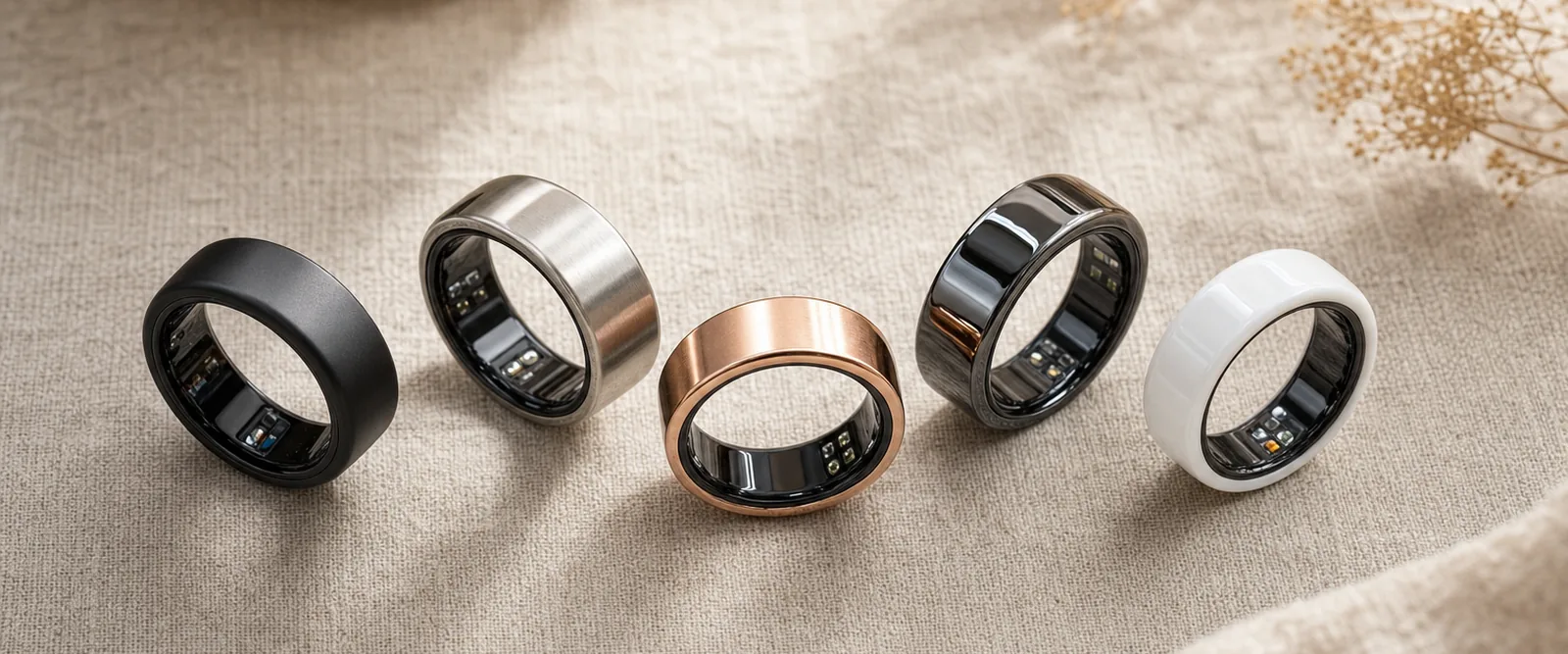
From Oura's gold-standard sleep algorithms to RingConn's subscription-free value, we break down the five best smart rings to wear in 2026 -- and tell you exactly which one to buy.
By AI Wearable Hub Editorial Team · Published
Affiliate Disclosure: AI Wearable Hub is reader-supported. We participate in the Amazon Associates program -- if you buy through links on this page, we may earn a commission at no extra cost to you. We research these products independently, and our editorial opinions are our own.
Quick Verdict
The Oura Ring Gen 3 is the best smart ring for most people in 2026: its sleep stage algorithms are the most validated in the category, its Readiness Score is genuinely useful for day-to-day decisions, and the app has years of refinement behind it. If you are embedded in Samsung's ecosystem and want to skip a monthly subscription, the Samsung Galaxy Ring is a strong second choice with a featherlight design and a portable charging case that nothing else in this group offers. Athletes focused on circadian timing and metabolic health should look at the Ultrahuman Ring Air before committing to Oura. For everyone else who wants subscription-free tracking with class-leading battery life, the RingConn Smart Ring is a hard ring to argue against at $299.
How We Evaluate Smart Rings
We assessed each ring across five weighted criteria: sleep tracking depth and validated accuracy, HRV measurement methodology, battery life under continuous monitoring, physical comfort during extended daily wear, and total cost of ownership including any subscription fees. Sleep and HRV were weighted most heavily because they are the primary reason to buy a ring over a smartwatch. We cross-referenced manufacturer spec sheets with long-term evaluations from The Verge, Tom's Guide, Android Central, Wareable, and Live Science, and we considered real-world battery results rather than rated maximums. We also looked at ecosystem fit -- a ring that requires an Android phone is simply not the same product as one that works identically on iOS. See our broader best health wearables guide for how rings fit into a larger tracking stack.
Prices shown are sourced from Amazon at time of writing and update automatically when our price tracker detects changes. We never invent product specs or copy customer review text.
1. Oura Ring Gen 3 -- Best Overall
The Oura Ring Gen 3 is a titanium smart ring available in Heritage and Horizon form factors that tracks sleep stages, HRV, resting heart rate, blood oxygen, skin temperature, and daily activity. It ships in sizes 6 through 13, weighs between 4 and 6 grams depending on size, and carries a 100-meter water-resistance rating with no formal IP ingress rating needed. Inside, three LED clusters and an array of infrared PPG sensors sit against the underside of the finger -- the optimal site for minimizing motion artifact. The ring syncs to Oura's iOS and Android app via Bluetooth Low Energy and connects to Apple Health, Google Fit, Health Connect, and Strava, among other platforms.
In daily use, the Oura Ring Gen 3 earns its reputation as the category benchmark for sleep science. The manufacturer reports 79 percent agreement with polysomnography for 4-stage sleep classification (wake, light, deep, and REM), which is among the highest published figures for any consumer wearable. Every morning the app delivers a Sleep Score built from seven sub-components including latency, timing, restfulness, REM percentage, and deep sleep duration, and a Readiness Score that aggregates overnight HRV, resting heart rate, body temperature deviation, and prior activity load into a single 0-to-100 number. The Resilience Score -- a newer addition -- measures how consistently your body recovers from physiological stress over rolling weeks rather than just the night before, which makes it useful for identifying cumulative fatigue that single-night scores can miss. Automatic Activity Detection covers over 30 workout types, and the app supports phone-GPS-assisted route tracking for outdoor runs. The ring has no vibration motor, which means no smart alarm or in-ring haptic feedback -- a genuine omission compared to Whoop and some smartwatches.
The subscription is the most discussed downside, and it is a real one. Oura charges $5.99 per month or $69.99 per year to unlock the detailed insights behind each score -- without a membership, the ring is largely a data paperweight. Over two years, a Gen 3 owner pays an additional $140 on top of the hardware price. The Gen 3 also predates the Gen 4's fully titanium interior; the Gen 3 uses an epoxy resin inner lining that most wearers find fine but that is a step below the Gen 4's all-titanium construction. Battery life is rated at up to 7 days; reviewers consistently find 6 days in real-world use with sleep tracking and always-on heart rate enabled, and charging from 0 to 100 percent takes about 80 minutes. The size range of 6 to 13 excludes wearers with very small or very large fingers, where the newer Gen 4 (sizes 4 to 15) has an advantage.
At currently $339 on Amazon, the Oura Ring Gen 3 is $10 less than the Gen 4's entry price, making it one of the better-value ways into the Oura ecosystem right now. Factor in the subscription and the total cost over 12 months runs about $410, which is competitive against a dedicated fitness band but meaningfully more expensive than the subscription-free alternatives below. It has not been at an observed 30-day low recently, though holiday and Prime Day discounts have historically pulled it below $280.
Check Oura Ring Gen 3 on Amazon
2. Samsung Galaxy Ring -- Best for Samsung Users
Samsung's Galaxy Ring is the lightest ring in this group, weighing just 2.3 to 3 grams across sizes 5 through 13. It is made from Grade 5 titanium, measures 7mm wide and 2.6mm thick, and carries both an IP68 and 10 ATM water-resistance rating -- verified to withstand 100 meters of depth for up to 10 minutes. The sensor array includes two photodiodes, two LEDs, and red and infrared lasers capable of tracking heart rate, HRV, SpO2, skin temperature, and breathing rate. It ships in Titanium Black, Titanium Silver, and Titanium Gold, and it comes with a 361mAh portable charging case -- a feature Oura still does not offer -- that provides roughly 1.5 additional full charges on the go. Crucially for budget-conscious buyers, there is no subscription fee: everything Samsung Health offers for the Galaxy Ring is included in the $399 purchase price.
Day to day, the Galaxy Ring is the easiest ring in this group to forget you are wearing. At under 3 grams, it sits lighter than most jewelry and the 7mm width keeps the profile narrow. The ring converts overnight biometric data -- sleep stages, resting heart rate, skin temperature deviation, and HRV -- into an Energy Score each morning, essentially Samsung's equivalent to Oura's Readiness Score. On Galaxy phones, Samsung's Galaxy AI layer interprets the score and delivers personalized recommendations; on non-Samsung Android phones, the Energy Score still populates but the AI commentary is limited. The portable charging case is a genuine differentiator: pull the ring off during a shower, drop it in the case, and it hits 40 percent charge in 30 minutes without hunting for a wall outlet. That said, Android Central's long-term testing found battery degradation to be notable after six months, with one size-10 ring dropping from a rated 6 days to closer to 2 days after a year of use -- a concerning data point for longevity.
The Galaxy Ring's biggest limitation is ecosystem lock-in. It does not support iPhone at all, and even on non-Samsung Android phones, core features like Samsung Health sleep analysis and the Galaxy AI Energy Score interpretation are reduced. Fitness tracking is also comparatively shallow: the ring auto-detects walks and runs but lacks the breadth of workout modes or recovery analysis depth found on Oura or Ultrahuman. Our full side-by-side is available at Oura Ring Gen 3 vs. Samsung Galaxy Ring. The ring earned some criticism from reviewers for accuracy inconsistencies at higher heart rate ranges during exercise, which is less of a concern given that it is primarily a resting and sleep tracker.
At currently $399 on Amazon, the Galaxy Ring is the priciest entry in this roundup, but the absence of a subscription fee means a Samsung phone owner who uses it for two years spends $399 total -- less than Oura's hardware plus two years of membership at roughly $479 combined.
Check Samsung Galaxy Ring on Amazon
3. Ultrahuman Ring Air -- Best for Athletes and Metabolic Focus
The Ultrahuman Ring Air is a titanium smart ring reinforced with Tungsten Carbide Carbon coating, weighing 2.4 to 3.6 grams across sizes 5 through 14 and measuring 8.1mm wide with a thickness of 2.45 to 2.8mm. It tracks heart rate, HRV (reported in both SDNN and RMSSD metrics), SpO2, skin temperature, and movement via a 6-axis motion sensor suite, and it is water-resistant to 100 meters. The companion app is available for iOS 15 and Android 6 and above, syncs to Apple Health and Google Fit, and requires no subscription for core features -- including access to all sleep stage data, the Daily Recovery Score, and the Movement Score. Optional premium add-ons called PowerPlugs (such as AFib monitoring) carry a separate fee, but of the roughly 20 available PowerPlugs only about 6 require any payment. All essential metrics are free for life.
Where Ultrahuman differentiates itself from the competition is the depth of its circadian and recovery coaching. Beyond standard sleep stages, the app surfaces a Phase Response Curve showing how light exposure, meal timing, and exercise have shifted your circadian clock, and it generates personalized caffeine cutoff windows and optimal bedtime suggestions based on your current rhythm. For athletes specifically, the Dynamic Recovery Score draws on SDNN and RMSSD HRV metrics alongside skin temperature deviation and sleep quality to grade recovery readiness in a way that is more granular than Samsung's Energy Score. The ring can also be paired with Ultrahuman's M1 continuous glucose monitor for correlations between blood sugar, sleep quality, and recovery -- a genuinely unique metabolic layer that no other ring in this group supports. PCMag noted that the Ring Air tracks over 50 workout types, including a live heart rate mode (in beta) for real-time training zone data during sessions.
Battery life is the Ultrahuman Ring Air's most consistent criticism. The manufacturer rates it at 4 to 6 days, and multiple independent reviewers found real-world performance closer to 3 to 5 days depending on feature usage -- meaningfully shorter than Oura's 6-day real-world average and well behind RingConn's 8-plus days. The ring charges via a compact cradle in about 3 hours from 0 to 100 percent, which is slower than Oura. Sleep accuracy has also drawn mixed assessments: a head-to-head test by Hello Code found Ultrahuman consistently attributed more time as sleep during awakenings compared to Oura, though the company pushed a firmware fix in late 2024 that narrowed the gap. Business Insider's long-term tester flagged spotty workout tracking data as a secondary concern. Note that Ultrahuman has had intermittent US availability challenges following a patent dispute with Oura in late 2025; verify availability at your preferred retailer before purchasing, as the ring listed at ASIN B0CXJ5DCSC may show as currently limited or fulfilled by third-party sellers.
At currently $349 on Amazon -- matching the Oura Ring Gen 3's territory while carrying no subscription -- the Ultrahuman Ring Air offers strong long-term value for wearers who want deep data without ongoing fees. Not known to be at a 30-day price low currently.
Check Ultrahuman Ring Air on Amazon
4. RingConn Smart Ring -- Best Subscription-Free Value
The RingConn Smart Ring (Gen 2) is an aerospace-grade titanium alloy ring with a PVD coating and medical-grade epoxy resin interior. It weighs 2 to 3 grams depending on size -- among the lightest titanium rings available -- measures 6.8mm wide and just 2mm at its thinnest point, and is IP68-rated to 100 meters. Available in sizes 6 through 14 in Black, Gold, or Silver, it tracks heart rate, SpO2, skin temperature, respiratory rate, steps, and sleep stages including REM and deep sleep. Its headline differentiator over every other ring in this group is sleep apnea detection: RingConn monitors oxygen desaturation events overnight and flags patterns consistent with obstructive sleep apnea, a feature that neither Oura Gen 3, Samsung Galaxy Ring, nor Ultrahuman Ring Air includes as a standard free feature. Crucially, every feature works without any subscription fee. The ring ships with a clamshell charging case that holds 12 to 15 full recharges, capable of extending total runtime to over 150 days between wall outlet visits -- a remarkable travel proposition.
In daily use, the RingConn Gen 2's defining characteristic is its staying power. The manufacturer rates battery life at 10 to 12 days depending on ring size, and Tom's Guide real-world testing confirmed approximately 8 days of continuous wear -- still beating every other ring here in practice. The RingConn app delivers a daily Sleep Score, a Wellness Score, Relax Status, and Vitals Status on a 0-to-100 scale, along with AI-powered tips for improving sleep. Wareable's review found sleep, heart rate, and SpO2 monitoring solid for everyday use, with step-count accuracy comparable to the Oura Ring Gen 3 and a Garmin GPS watch. The ring stores up to 7 days of data onboard, so syncing once a week does not create data gaps. It works identically on iOS and Android. RingConn claims 98 percent accuracy for heart rate and SpO2 sensors, and approximately 95 percent step-count accuracy, though these figures come from the manufacturer rather than independent third-party validation against clinical references.
The RingConn Gen 2 is not without tradeoffs. Fitness tracking remains limited: Wareable's reviewer found heart rate data erratic during outdoor runs, and the ring supports a modest number of workout modes compared to Oura or Ultrahuman. The app, while improved in recent software updates, is not as polished or insight-rich as Oura's -- it surfaces good data but provides less interpretive coaching. The ring lacks a vibration motor for haptic alerts and has no on-ring battery indicator. Wareable's original review also noted the app felt busy, though CGMagazine's 2025 hands-on found the redesigned interface considerably cleaner.
At currently $299 on Amazon, the RingConn Smart Ring is the best-value proposition in this group for anyone who prioritizes battery life, sleep apnea detection, and zero ongoing fees. Check the AI Wearable Hub deals page for current discount codes, as RingConn runs periodic promotions on its own site.
Check RingConn Smart Ring on Amazon
5. Amazfit Helio Ring -- Best Budget Pick
The Amazfit Helio Ring is a titanium alloy smart ring that undercuts every other entry in this roundup at currently $182 on Amazon. It measures 8mm wide and 2.6mm thick, weighs between 3.65 and 3.82 grams depending on size, and is rated to 10 ATM water resistance. The sensor package includes a BioTracker PPG sensor for heart rate and SpO2, a skin temperature sensor, an electrodermal activity (EDA) sensor for stress monitoring, a 3-axis accelerometer, and a 3-axis gyroscope -- the EDA sensor is a notable inclusion that Samsung, RingConn, and Ultrahuman do not offer at the core product level. The ring is currently available only in sizes 8, 10, and 12 in a single Bronze titanium finish, and it syncs to Amazfit's Zepp app on iOS and Android with no mandatory subscription fee.
The Helio Ring integrates well if you already own an Amazfit watch, with Readiness Score calculations that combine ring and watch data in a single Zepp dashboard. Sleep tracking quality impressed Live Science's two-month test, with accurate detection of sleep duration, quality, and naps. The EDA-based stress monitoring adds a dimension of physiological stress tracking that is genuinely useful for knowledge workers who want more than pure sleep and HRV data. Tom's Guide found that four days of battery life was achievable in practice with EDA enabled, and the ring charges in under two hours from a USB-C cradle.
Battery life is the Helio Ring's most significant weakness and it is hard to paper over. Most reviewers -- including The Verge, Live Science, and Android Central -- found real-world runtime closer to 3 to 3.5 days, not the manufacturer's 4-day claim. For a ring that exists primarily to track sleep, needing to charge every third day is a real problem: a forgotten charge the night before an important rest day produces a data gap at exactly the wrong time. The size range of 8, 10, and 12 only excludes a meaningful portion of buyers -- anyone who wears a 7, 9, 11, or 13 has no option here. The Zepp app has been criticized for a confusing interface and upselling behavior, and Android Central noted the absence of Health Connect integration. The Verge concluded that outside of an existing Amazfit ecosystem, the Helio Ring does not present a compelling case even at its low price.
At currently $182 on Amazon, the Amazfit Helio Ring is a reasonable starting point for someone who owns an Amazfit watch and wants a ring to complement it, or for a first-time smart ring buyer who is not ready to commit to Oura's subscription model and wants to spend as little as possible to try the form factor. It has appeared at lower prices periodically, so check the deals page before buying.
Check Amazfit Helio Ring on Amazon
Comparison Table
| Ring | Price | Subscription | Battery (rated) | Standout |
|---|---|---|---|---|
| Oura Ring Gen 3 | $339 | $5.99/mo or $69.99/yr | Up to 7 days | Best-in-class sleep algorithms + readiness coaching |
| Samsung Galaxy Ring | $399 | None | Up to 7 days (5-6 typical) | Seamless Samsung Health integration + portable charging case |
| Ultrahuman Ring Air | $349 | None (add-ons optional) | 4-6 days | Circadian coaching + optional glucose pairing |
| RingConn Smart Ring | $299 | None | 10-12 days + 150-day case | Longest battery life + sleep apnea detection |
| Amazfit Helio Ring | $182 | None (some add-ons optional) | Up to 4 days | Lowest entry price + EDA stress sensor |
How to Choose a Smart Ring
Get your sizing right before anything else
Every major smart ring brand offers a free sizing kit, and you should order one before committing to a ring purchase. Smart ring sizing does not map one-to-one with standard US jewelry ring sizes. Oura's sizing kit uses black plastic sizers numbered 6 to 13; Samsung's kit covers sizes 5 to 13; RingConn and Ultrahuman both offer kits spanning sizes 5 or 6 through 14. Wear the sizer on your intended finger overnight -- fingers swell slightly during sleep, and a ring that fits perfectly at 9 am may feel tight by morning. Oura specifically recommends sizing in the evening when fingers are at their largest. None of these rings come in half sizes. If you are between sizes, size up: a slightly loose ring is more comfortable than a too-tight one, though a very loose ring will spin and generate inaccurate HRV data.
Which finger you wear the ring on also matters. Oura and most manufacturers recommend the index or middle finger for best sensor contact. The ring finger is fine for comfort but is often the widest finger on a hand, so size carefully. Avoid the pinky unless it is your only comfortable fit -- the skin there tends to be thinner and PPG accuracy can suffer. For a deeper look at how ring-based trackers compare to wrist-based wearables, see our smart rings category page or take the wearable fit quiz to find the right tracker for your lifestyle.
Subscription versus no subscription: run the numbers
Oura's $5.99 per month membership adds $71.88 per year in ongoing cost. Over two years, that is $143.76 on top of a $339 hardware purchase, bringing your total to about $483. The Samsung Galaxy Ring costs $399 with no recurring fees, so a Galaxy Ring owner pays less in total over two years than an Oura owner despite the higher upfront price. RingConn and Ultrahuman are even more favorable on total cost of ownership. The subscription calculus only favors Oura if you genuinely use the deeper coaching features that the membership unlocks -- the Readiness breakdowns, trend analysis, and algorithm-driven health recommendations. If you plan to glance at your score each morning and not dig into the data, the subscription adds less value. Oura does offer a one-month free trial, which is worth using before committing.
Ecosystem fit determines what your ring actually does
Samsung Galaxy Ring is the only ring here that requires Android and works best with a Samsung Galaxy phone. iPhone users should choose Oura, RingConn, or Ultrahuman -- all three sync to Apple Health natively. Amazfit's Zepp app covers iOS and Android but integrates most cleanly with other Amazfit hardware. If you own a Samsung Galaxy Watch 7 or Ultra, pairing it with the Galaxy Ring extends the ring's battery by up to 30 percent by sharing sensor load between devices. See the full Oura vs. Samsung Galaxy Ring comparison for a deeper ecosystem breakdown.
FAQ
Do smart rings require a subscription?
Only Oura does among this group. The Gen 3 charges $5.99 per month or $69.99 per year to unlock most health insights. Samsung Galaxy Ring, RingConn Smart Ring, Ultrahuman Ring Air, and Amazfit Helio Ring all deliver core features without ongoing fees. Ultrahuman charges separately for a handful of advanced PowerPlugs, but sleep and HRV data are free for life.
How accurate is HRV tracking on smart rings?
Finger-based PPG sensors measure HRV well during sleep, when the hand is still. Oura reports 79 percent agreement with polysomnography for 4-stage sleep classification. Ultrahuman has published internal data showing the Ring Air matches an FDA-cleared sleep device to within 2.4 beats per minute mean absolute error on resting heart rate. During exercise, no smart ring in this group provides reliable beat-to-beat HRV data.
Which smart ring has the best battery life?
RingConn Smart Ring (Gen 2) leads with a rated 10 to 12 days, and its portable charging case extends runtime to over 150 days between wall outlet visits; Tom's Guide confirmed about 8 days in real-world use. Samsung and Oura both reach around 6 days in practice. Ultrahuman averages 4 to 5 days, and the Amazfit Helio Ring lands at about 3 to 3.5 days based on multiple independent reviews.
Can I wear a smart ring in the pool or shower?
All five rings are rated to at least 100 meters (10 ATM), so showering, casual swimming, and light water sports are fine. The Samsung Galaxy Ring also carries an IP68 rating. Rinse any ring with fresh water after pool or ocean use, and avoid submersion beyond rated depths.
How do I find my smart ring size?
Order the brand's free sizing kit first -- smart ring sizing does not match standard jewelry sizing. Wear the plastic sizer on your intended finger overnight, then order accordingly. Oura recommends sizing in the evening when fingers are at their largest. No brand in this group offers half sizes, so when in doubt, size up.
Which smart ring works with iPhone?
Oura Ring Gen 3, RingConn Smart Ring, Ultrahuman Ring Air, and Amazfit Helio Ring all fully support iOS and Android. Samsung Galaxy Ring requires Android 11 or higher and does not support iPhone; its best features require a Samsung Galaxy phone specifically.
Is the Oura Ring Gen 3 still worth buying now that the Gen 4 is out?
Yes. At $339 it is a strong value -- the Gen 4 adds a fully titanium interior and a wider size range (4 to 15 versus 6 to 13) but uses nearly identical sensors and algorithms. If you find the Gen 3 at a meaningful discount, it remains excellent hardware. See our Oura Ring vs. Samsung Galaxy Ring comparison for a deeper look.
Bottom Line
Smart rings have matured significantly, and the five options here cover the full spectrum from Oura's subscription-backed health coaching to RingConn's no-fee, best-in-class battery. For most buyers, the Oura Ring Gen 3 at $339 earns its position at the top of this list through years of algorithm refinement, the deepest sleep stage analysis in the category, and an app that actually teaches you something about your health rather than just displaying numbers. The Samsung Galaxy Ring is the smarter financial choice for Android and Galaxy phone owners who want similar nightly insight without any ongoing fees. The RingConn Smart Ring is the pick I would hand to a frequent traveler or anyone for whom charging cadence is a genuine daily friction point. Personally, I find the Oura app's Readiness coaching to be the feature that actually changes my behavior -- it has, more than once, talked me out of an ill-timed hard training day -- and that is worth the subscription fee to me. For everyone else, the subscription-free field has caught up considerably, and there has never been a better time to skip the monthly bill.
Products Covered
- Oura Ring Gen 3 — $339.00 by Oura
- Samsung Galaxy Ring — $399.99 by Samsung
- Ultrahuman Ring Air — $349.00 by Ultrahuman
- RingConn Smart Ring — $299.00 by RingConn
- Amazfit Helio Ring — $182.95 by Amazfit
Amazon links are affiliate links (paid links). As an Amazon Associate we earn from qualifying purchases.
Frequently Asked Questions
Do smart rings require a subscription?
It depends on the brand. Oura Ring Gen 3 requires a $5.99 per month (or $69.99 per year) membership to unlock most health insights. The Samsung Galaxy Ring, RingConn Smart Ring, Ultrahuman Ring Air, and Amazfit Helio Ring all offer their core features with no ongoing subscription fee, though Ultrahuman does charge extra for certain advanced add-on PowerPlugs.
How accurate is HRV tracking on smart rings?
Finger-based PPG sensors generally measure HRV with reasonable accuracy during sleep, when the hand is still. Oura Ring Gen 3 achieves 79 percent agreement with polysomnography for 4-stage sleep classification, according to the manufacturer. Ultrahuman has published internal data showing its Ring Air matches FDA-cleared sleep devices to within about 2.4 beats per minute mean absolute error on resting heart rate. Wrist-based devices tend to have more motion artifact than ring-based ones, which gives smart rings a modest edge for overnight HRV.
Which smart ring has the best battery life?
The RingConn Smart Ring (Gen 2) leads the group with a manufacturer-rated 10 to 12 days per charge, backed by a portable charging case that can extend runtime to over 150 days without a wall outlet. The Samsung Galaxy Ring and Oura Ring Gen 3 both hit around 6 to 7 days in real-world use. The Ultrahuman Ring Air typically lands at 4 to 6 days, and the Amazfit Helio Ring is the weakest performer at around 3 to 4 days in practice.
Can I wear a smart ring in the pool or shower?
All five rings covered here are water-resistant to at least 100 meters (10 ATM), so showering, swimming, and light water sports are fine for all of them. The Samsung Galaxy Ring carries an IP68 rating alongside its 10 ATM certification. None of these rings are certified for scuba diving depths. Saltwater or chlorinated pool exposure over extended periods is generally not recommended by manufacturers, so rinse the ring with fresh water after swimming.
How do I find my smart ring size?
Smart rings do not follow standard US ring sizes exactly. Every major brand -- Oura, RingConn, Ultrahuman, and Samsung -- offers a free plastic sizing kit. Order it before you order the ring, wear the sizer on your target finger overnight, and select accordingly. Finger circumference can fluctuate with temperature, hydration, and time of day, so Oura recommends sizing in the evening when fingers tend to be slightly larger. Half sizes are not available on any of these rings.
Which smart ring works with iPhone?
The Oura Ring Gen 3, RingConn Smart Ring, Ultrahuman Ring Air, and Amazfit Helio Ring all fully support iOS and Android. The Samsung Galaxy Ring officially requires Android 11 or higher and functions best with a Samsung Galaxy phone; its Energy Score and Galaxy AI features are substantially limited or unavailable on non-Samsung Android phones, and it does not support iPhone at all.
Is the Oura Ring Gen 3 still worth buying now that the Oura Ring 4 is out?
Yes, at its current price of $339 on Amazon, the Gen 3 remains compelling. The Gen 4 starts at $349 and adds a fully titanium interior (the Gen 3 uses an epoxy resin lining) and an expanded size range of 4 to 15, but the core sensor suite and algorithms are nearly identical. If you can find the Gen 3 at a meaningful discount, it is still excellent hardware. Our detailed head-to-head is at /article/oura-ring-gen-3-vs-samsung-galaxy-ring.